Tuesday, February 23, 2010

Doubleislander's dedication

Doubleislander's dedication

The problems on this post were sent as a present to the composition contest [Jubilee Tourney Emmanuel Manolas-60] by a friend who prefers to be anonymous. We will name him/her as Doubleislander (from two islands).
The problems are quite simple, but the pieces are set in a way to represent the symbols J T E M 6 0 (initials from the name of the tourney).
We thank the Thrilling Anonymous!


(Problem 429)
Doublislander,
dedicated to JT Manolas-60,
original,
Helpmate in 2. Condition : Circe.
h#2 Circe (4 + 8)
[8/3prssb/5k2/5r2/5b2/3P1K2/4QP2/8]


With condition Circe, the captured piece is reborn on its initial square (example : the wQ on d1).


(Problem 430)
Doublislander,
dedicated to JT Manolas-60,
original,
Helpmate in 2. Condition : Chameleon - Chess.
h#2 Chameleon Chess (3 + 7)
[8/1pppkp2/3b4/3p4/3P4/3S4/3K4/8]


Helpmate : Black plays and helps White to mate.
With condition Chameleon - Chess, the moving pieces are transformed (i.e. the Knight moves and becomes Bishop, the Bishop moves and then becomes Rook, the Rook moves and then becomes Queen, the Queen moves and then becomes Knight).


(Problem 431)
Doublislander,
dedicated to JT Manolas-60,
original,
Selfmate in 2 moves.
s#2 (5 + 8)
[KSrb4/s7/qpp5/k7/pRPS4/8/8/8]


Selfmate : White plays and forces Black to deliver mate.


(Problem 432)
Doublislander,
dedicated to JT Manolas-60,
original,
Helpmate in 2 moves.
h#2 (3 + 10)
[8/2R3K1/2bp1pp1/2r1k1q1/2p3s1/2P3p1/8/8]


(Problem 433)
Doublislander,
dedicated to JT Manolas-60,
original,
Helpmate in 2 moves. Condition : Madrasi.
h#2 Madrasi (5 + 8)
[8/1PB5/p2r4/b7/pPp5/k2R4/rsK5/8]


With condition Madrasi, if two dissimilarly coloured pieces of the same kind (i.e. wR and bR) are mutually threatened, then they are paralyzed and the only power they have, whilst the threat is pending, is to paralyze each other.


(Problem 434)
Doublislander,
dedicated to JT Manolas-60,
original,
Helpmate in two moves. Condition AntiCirce.
h#2 Anticirce (5 + 7)
[8/3pp3/2r2R2/2b2P2/2P2S2/2k2r2/3sK3/8]


With condition Anticirce, the capturing piece is reborn in its initial square. The captured piece disappears.


The solutions will be posted here in a few days.

Friday, February 19, 2010

A study by Libiurkin and one (more) imitation

The first study comes from the collection [1234 Modern End-Game Studies], and is a composition by M. S. Libiurkin. In this pretty study White mates in 23 moves, but in the meantime has promoted five pawns to Knights and has allowed to Black three Queenings. (Unfortunally, this study is cooked, because the promotion 1.d8=Q! leads to a shorter solution).

The second study, by Manolas Emmanuel, contains no pieces, only pawns. The goal is to show the Phoenix theme, in triplicate.

In the two studies the mechanism of Knight production is similar, the road to victory is different.

Theme Phoenix : A pawn is promoted to a piece which was previously captured.


(Problem 427)
M. S. Libiurkin,
"1234 Modern End-Game Studies", 1938,
White plays and wins.
+ (10 + 10)
[8/p1pPp1p1/P1P1P1P1/2p5/3P4/5P1P/K2p2pp/3R2sk]


White can not win with 1.d8=Q?, because 1...cxd4 is threatening draw.
Key : 1.d8=S!
1...cxd4 2.Sf7 d3 3.Sh6 gxh6 4.g7 h5 5.g8=S!
(not 5.g8=Q? h4 with draw threat)
5...h4 6.Sf6 exf6 7.e7 f5 8.e8=S! f4 9.Sd6 cxd6 10.c7 d5
11.c8=S! d4 12.Sb6 axb6 13.a7 b5 14.a8=S! b4 15.Sb6 b3+
16.Ka3 b2 17.Sc4 b1=Q 18.Rxb1 d1=Q 19.Rxd1 d2 20.Sb2 d3
21.Ra1 d1=Q 22.Sxd1 ~ 23.Sf2#


(Problem 428)
Manolas Emmanuel,
dedicated to M. S. Libiurkin,
original, 20090310,
White plays and wins.
+ (8 + 8)
[8/1p1p1p1P/1P1P1P2/8/4p3/6p1/2P1PpPp/5K1k]


Key : 1.h8=S! e3 2.Sg6 fxg6 3.f7 g5 4.f8=S g4 5.Se6 dxe6
6.d7 e5 7.d8=S e4 8.Sc6 bxc6 9.b7 c5 10.b8=Q c4
11.Qxg3 c3 12.Qxe3 g3 13.Qxg3 e3 14.Qxh2+ Kxh2 15.g4 Kf3
16.g5 Kf4 17.g6 Ke5 18.g7 Kd4 19.g8=Q +-
(possible continuation :
19...Kc5 20. Qb3 Kd4
21.Qb4+ Ke5 22.Qxc3+ Ke4 23.Qd3+ Ke5 24.c4 Kf4 25.c5 Ke5
26.c6 Kf6 27.c7 Kg5 28.c8=Q Kf6 29.Qdf5+ Kg7 30.Qcf8#)

Triple repetition of the Phoenix theme, in moves (2, 4), (5, 7) and (14, 19).


08-04-2010 : The good problemist Ioannis Garoufalidis, has notified me that my problem is anticipated.
The composition is a tough job!

Hello Emmanuel
Your study is anticipated (almost mirrored !!!)

(Problem 447)
Karhia V
First prize, Suomen Shakki, 1943
White plays and wins.
+ (8 + 8)
[8/2p1p1p1/P1P1P1P1/1p6/8/3p4/pPpP1P2/k1K5]

1.a7! b4 2.a8=S! b3 3.Sb6 cxb6 4.c7 b5 5.c8=S b4 6.Sd6 exd6 7.e7 d5 8.e8=S d4 9.Sf6 gxf6 10.g7 f5 11.g8=Q f4 12.Qxb3 f3 13.Qxd3 b3 14.Qxb3 d3 15.Qxa2+! Kxa2 16.b4 1–0

See also newspaper "Apogevmatini of Saturday" (column by Siaperas) 23-10-1976

regards
Ioannis Garoufalidis

Sunday, January 24, 2010

Solving Contest 2010-01-24, ISC 6

Sixth International Parallel Solving Contest

The Greek announcement : here. In Athens Greece, Sunday January 24, 2010. Organiser : Harry Fougiaxis, email: harryfou@ath.forthnet.gr


Greek solvers in category-1 :
Kostas Prentos, Panagiotis Konidaris, Philip Terzis, Athanassios Spiliadis, Apostolos Stamatopoulos, Constantinos Smpoukis, Giorgos Finokaliotis, Nikodimos Kotrotsos, Giorgos Stamatopoulos, Emilios Lefteriotis, Clelia Lykothanassi, Emmanuel Manolas.

Congratulations to the Greek champion Kostas Prentos (from Thessaloniki), to Panagiotis Konidaris (from the island Meganissi near Lefkada), to Philip Terzis (from Patras).

We present now the problems of the contest, first the 8 of the easy category-2 and then the 12 of the more difficult category-1.


Category 2

(Problem 407)
O. Stocchi,
3rd Prize, l' Enigmistica Popolare, 1935,
Mate in 2.
#2 (7 + 4)
[5K2/1s6/8/5R2/kS4Q1/qpP5/8/R4B2]


Set play 1...Qxa1,Qa2 / b2 / Sa5 2.Sc2# / Qd1# / Bb5#
Tries [1.Qc4? b2!], [1.Qe4? Sc5!]
Key 1.Qd4! (5) ( > 2.Qd7# )
1...Qxa1,Qa2 / b2 / Sa5 / Sc5 / Sd6,Sd8
2.Sc2# / Qd1# / Bb5# / Sc6# / Qa7#


(Problem 408)
B. Atanackovic,
Yug. Sahovski glasnik, 1956,
Mate in 2.
#2 (5 + 8)
[8/6K1/3pp3/4kp2/1s1p4/sQ2p1P1/1S6/7B]


Key : 1.Qc2! (5) Zugzwang
1...d5 / Saxc2 / Sbxc2 / d3 / e2 / f4
2.Qc7# / Sc4# / Sd3# / Qc3# / Qxe2# / Qe4#
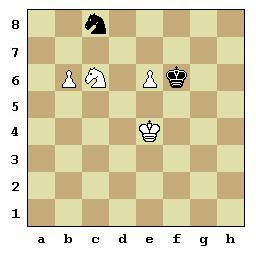

(Problem 409)
L. Prokes,
1st - 2nd Prize, Gros, 1938,
White plays and wins.
+ (4 + 2)
[2s5/8/1PS1Pk2/8/4K3/8/8/8]


Key : 1.b7! (1) Sd6+ 2.Kd4! (1) [i] Sxb7 3.Kd5! (1) Kg7 [ii] 4.Sd8! (1) Sxd8 5.e7! (1) Sf7 6.e8Q +

[i] 2.Kd5? Sxb7!
[ii] 3...Sc5 4.e7 Se6 [iii] 5.Kd6 Sg7 6.Kd7 Kf7 7.Sd8+ K~~ 8.Se6
[iii] 4...Sa6 5.Kd6 Kf7 6.Sd8+ Ke8 7.Se6 Kf7 8.Sg7 Sc7 9.Kd7 Kf6 10.Se8+


(Problem 410)
Pavlos Moutecidis,
1st Prize, Biuletyn, 1959,
Selfmate in 2 moves.
s#2 (7 + 7)
[6Bk/5Rs1/5S2/4Q2P/8/3ppp2/4p1p1/4K1S1]


Set play 1...Se6 / Sxh5 / Se8 2.Qxe6 / Qh2 / Qxe8 d2,f2#
Key : 1.Bh7! Zugzwang
1...Se6 2.Qxe6 (1,25) d2,f2#
1...Sf5 2.Bxf5 (1,25) d2,f2#
1...Sxh5 2.Qxh5 (1,25) d2,f2#
1...Se8 2.Qb8 (1,25) d2,f2#


(Problem 411)
I. Draiska,
1st Prize, Lett. Ty, 1958,
Mate in 2.
#2 (8 + 6)
[B1s2s2/2B3p1/5Q2/1p2S3/2bk1S2/5P2/2R5/7K]


Set play 1...Kc5 / Ke3 2.Sed3# / Sg4#
Try [1.Qh4? ( > 2.Qf2# ), 1...Kc5 / Ke3 2.Sfd3# / Sg2#, 1...Sd6!]
Key : 1.Qg5! (5) ( > 2.Qg1# )
1...Kc5 / Ke3 / Sd6 2.Sc6# / Se6# / Bb6#


(Problem 412)
M. Lipton,
2nd Prize, Sunday Citizen Ring Ty, 1966,
Mate in 2.
#2 (6 + 5)
[2K1k3/1R4BS/3R4/5Ss1/8/2b5/4r3/3r4]


Tries [1.Be5? Sxh7!], [1.Rd4? Re6!], [1.Sd4? Re7!]
Key : 1.Bd4! (5) ( Novotny, > 2.Sg7#,Rd8# )
1...Rxd4 / Bxd4 / Re7,Se6 2.Sg7# / Rd8# / R(x)e7#


(Problem 413)
W. M. Archakov & J. Gorbatenko,
3rd Hon. Mention, "64", 1978,
Mate in 3.
#3 (7 + 10)
[8/Ks6/5p1q/pQ3S1r/5S1p/k3P1R1/1p4p1/1B4b1]


Key : 1.Sd5! ( > 2.Qd3+ (1,25) Ka4 3.Bc2#)
1...Bxe3+ 2.Sd4 (1,25) ( > 3.Qb3# ) Sc5 / a4 3.Sc2# / Qd3,Qb4#
1...Qxe3+ 2.Sb6 (1,25) ( > 3.Qa4# ) Sc5 3.Sc4#
1...Sc5 2.Qxa5+ (1,25) Sa4 / Kb3 3.Qb4# / Qb4,a2#


(Problem 414)
B. Gadjanski,
1st Prize, Mat, 1977,
Helpmate in 2.
h#2 (5 + 12)
[8/8/4KS1q/2ppp3/Rssk4/2p5/3brrb1/3Q2B1]


I) 1.Sd3! Bh2 2.Be3 Bxe5# (2,5)
II) 1.Se3! Qb3 2.Rf3 Qxd5# (2,5)


Category 1

(Problem 415)
V. Kopaev,
Magyar Sakkelet, 1980,
Mate in 2.
#2 (9 + 10)
[S4q2/3pb3/p2k1pS1/2R2P2/s3P3/1Q2BKp1/5P2/3r3r]


Tries [1.Rc2? Rh4!], [1.Rc3? Rd3!], [1.Rc4? Rd5!], [1.Rc7? Qh6!]
Key : 1.Rc1! (5) ( > 2.Bf4# )
1...Rxc1,Rd5 / Rd3 / Rh4 / Qh6 / Sc3,Sc5
2.Q(x)d5# / Qxd3# / Qxd1# / Qb8# / Qb6#


(Problem 416)
G. Backsi,
Magyar Sakkszovetzeg, 1959,
Mate in 3.
#3 (10 + 9)
[7B/r4p2/2B1ks2/p2p1S1p/K2p1R1P/3S3Q/P1P5/4r3]


Key : 1.Qg2! ( > 2.Qxd5+ (1,25) Sxd5 3.Sc5# )
1...Re4 2.Qg5 (1,25) ( > 3.Qf6# ) S~~ / Sd7 3.Sc5# / Qe7#
1...Rd7 2.Qg7 (1,25) ( > 3.Qxf6# ) S~~ / Se4 3.Sc5# / Qe5#
1...Se4 2.Qxe4+ (1,25) Rxe4,dxe4 3.Sc5#


(Problem 417)
U. Degener,
Championnat de RDA, 1987-88,
Mate in 6.
#6 (7 + 10)
[4B2s/r1p5/r1pp4/5PS1/4S2k/3p3P/5p2/B1s2K2]


Tries [1.Sf3+? Kxh3!], [1.f6? Sg6!], [1.Be5? dxe5!]
Key : 1.Bd4! ( > 2.Bxf2# )
1...Ra2 2.Be5 ( > 3.Bg3# )
__2...dxe5 3.f6 ( > 4.Sf3+ Kxh3 5.Bd7# )
____3...Sf7 4.Bxf7 ~~ 5.Sf3+ (*) Kxh3 6.Be6#
____3...Sg6 4.Bxg6 ~~ 5.Sf3+ (*) Kxh3 6.Bf5#
With one * = 4 points. With two * = 5 points.


(Problem 418)
J. H. Marwitz,
Schakend Nederland, 1984,
White plays and wins.
+ (4 + 5)
[2r5/7b/2RPK3/6pp/4k3/8/8/2S4]


1.Sc3+ [i] Kf4 2.Sd5+ Ke4 3.Sf6+ Kf4 4.Sxh5+ (1) Kg4 5.Sf6+ Kf4
6.Sd5+ Ke4 7.Sc3+ Kf4 8.Se2+! (2) Kg4 [ii] 9.Rxc8! (1) Bf5+ 10.Ke7 Bxc8
11.Kd8 Bf5/Ba6 12.Sd4! (1) +

[i] 1.Rxc8? Bf5+!
[ii] 8...Ke4? 9.Sg3+! ~~ 10.Rxc8.


(Problem 419)
Chr. Jones,
US Problem Bulletin, 1990,
Helpmate in 4 moves. Two solutions.
h#4 2.1.1.1... (6 + 11)
[8/1p3p1p/B2p3P/3PpPpP/K5k1/p7/r4q1R/8]


I) 1.Qa7! Rb2 2.Kxf5 Rxb7 3.Kf6 Rb3 4.Qe7 Rf3# (2,5)
II) 1.Qb2! Re2 2.Kxh5 Rxe5 3.Kxh6 Re3 4.Qg7 Rh3# (2,5)


(Problem 420)
W. Tura,
Magyar Sakkelet, 1985,
Selfmate in 4 moves.
s#4 (15 + 9)
[2R5/2B1p3/BPk1PP2/1S1p1Qp1/1P3pP1/1S3K2/p1s2PP1/rbR5]


Key : 1.Re8! Zugzwang
1...exf6 2.Qxd5+ Kxd5 3.Sc3+ Kc6 4.Sd4+ (2,5) Sxd4#
1...d4 2.Bb7+ Kxb7 3.Sc5+ Kc6 4.Sxd4+ (2,5) Sxd4#


(Problem 421)
J. C. Morra,
The Field, 1961,
Mate in 2.
#2 (10 + 9)
[1S2r3/1R6/K2pkP1B/1p2P3/1S5b/p1P2R1b/qp6/6Q1]


Set play 1...Kxe5 2.Qe3#
Tries [1.Qb6? Qd5!], [1.Qd1? / Qd4? d5!]
Key : 1.Qg6! (5) ( > 2.Qxe8# )
1...Bxf6 / dxe5 / Kxe5 / R~~
2.Qxf6# / Rb6# / Re3# / R(x)e7#


(Problem 422)
Dr E. Palkoska,
Tepl. Chemm. Anzeiger, 1922,
Mate in 3.
#3 (8 + 11)
[1b1Q2b1/2p3p1/4p1P1/1pP1k1Sp/1K2B3/2pp1P2/6s1/2B5]


Key : 1.Sh3! Zugzwang
1...d2 2.Qxd2 (1) ( > 2.Qxc3# ) cxd2 / Kf6 3.Bb2# / Qg5#
1...Se3 2.Bxe3 (1) ~~ 3.Qg5# / Qd4# / Bf4# / Bd4#
1...h4 2.Sf2 (1) ~~ 3.Sg4# / Sxd3#
1...c6 2.Qxb8 (0,5) Kf6 / Kd4 3.Bg5# / Qd6#
1...Ba7 2.Qxc7 (0,5) Kf6 / Kd4 3.Bg5# / Qd6#
1...Bf7 2.Bh7 (0,5) ( > 3.Bxg7# ) gxh6 3.Qh8#
1...Bh7 2.Bh7 (0,5) ( > 3.Bxg7# ) gxh6 3.Qh8#


(Problem 423)
P. Polak,
Pravda, 1977,
Mate in 4.
#4 (7 + 14)
[1sQ4K/r3B3/1p6/bp2pSp1/2p2k2/5Bp1/2PpPp2/1q2s3]


Key : 1.Qf8! ( > 2.Bxg5+ Kxg5 3.Qh6+ (1) Kxf5 4.e4# )
1...Qxc2 2.Sd6+ Ke3 3.Bxg5+ (1) Kd4 4.Sxb5#
__2...Qf5 3.Qxf5+ (1) Ke3 4.Qe4 (Qxe5)#
1...Sxf3 2.Sh6+ Ke4 3.Qxf3+ (0,5) Kd4 4.Sf5#
__2...Ke3 3.Qxf3+ (0,5) Kd4 4.Sf5#
1...Rxe7 2.Sxe7+ Ke3 3.Sd5+ (1) Kd4 4.e3#


(Problem 424)
T. B. Gorgiew,
Shakmatny Listok, 1929,
White plays and wins.
+ (3 + 5)
[8/3k4/1p2R1p1/4K3/8/8/2b1B3/6b1]


1.Bb5+! Kd8 2.Rd6+ (1) Ke7 3.Rd7+ Kf8! 4.Kf6 (1) Kg8! 5.Bc4+ Kh8!
6.Rd8+ (1) [i] Kh7 7.Bg8+ Kh6! 8.Bb3! (2) [ii] Bd4+ [iii] 9.Rxd4 Bxb3 10.Rh4#.

[i] 6.Rd2? Be4 =
[ii] 8.Be6? g5 =
[iii] 8...Bxb3 / g5,Kh5 9.Rh8# / Bxc2 +


(Problem 425)
V. Bunka & V. Kichigin,
Magyar Sakkelet, 1980,
Helpmate in 3 moves. Three solutions.
h#3 3.1.1.1... (5 + 12)
[8/3p4/1bbp1p1R/1p5B/8/PkPrr2p/pp6/6K1]


I) 1.Kxa3! Bf7 2.h2+ Rxh2 3.b1=S Rxa2#
II) 1.Rd4! Bf3 2.Rxc3 Rxh3 3.R3c4 Bd1#
III) 1.Kc4! Bf7+ 2.Kc5 Rh4 3.Rd4 cxd4#
One solution = 1,5 points / Two solutions = 3,5 points / Three solutions = 5 points.


(Problem 426)
C. Gamnitzer,
Thema Danicum, 1994,
Selfmate in 5 moves.
s#5 (14 + 11)
[1s6/br1P2R1/b2PQ3/4P1S1/1PS2kP1/P2prp1p/3BpK1P/4R1s1]


Key : 1.Bc1! ( > 2.Sd2 ~~ 3.Sxh3+ Sxh3# )
1...Bc5 2.b5 ( > 3.Sd2 > 4.Sxh3+ Sxh3# )
__2...Bb4 3.axb4 ( > 4.Sd2 > 5.Sxh3+ (1,25) Sxh3# )
__2...Ba7 3.bxa6 ( > 4.Sd2 > 5.Sxh3+ (1,25) Sxh3# )
____3...Rb2 4.Sxb2 ( > 5.Bxe3+ (1,25) Bxe3# ) d2 5.Sd3+ (1,25) Rxd3#

Thursday, January 14, 2010

Dedication for Manolas-60

The good composer Ioannis Garoufalidis has composed a "selfmate in 3 moves" problem, and has dedicated it to the Composition Contest Manolas-60 which is ending on 12 July 2010. We are thanking him warmly.

Let our readers try to solve this problem without peeking at the solution which is written at the bottom of this post.


(Problem 406)
Garoufalidis, Ioannis,
Dedicated to "JT Manolas-60",
Selfmate in 3 moves.
s#3 (12 + 2)
[7K/7R/1P3Sk1/2P1Q1P1/5PP1/8/PP6/qS6]


White plays and forces Black to mate in 3 moves. The solution has got three variations.


We give again the declaration of the Composition Contest Manolas-60, as it has appeared in various magazines and web sites.

International Chess Composition Contest : "Jubilee Tourney Manolas - 60", Closing date 2010-07-12.
The Greek committee for Chess Composition announces the "Jubilee Tourney Manolas – 60".
Theme free. Accepted are original three-mover chess problems in the following four sections:
A. direct mate #3, with at least three variations. Judge Emmanuel Manolas.
B. helpmate h#3, with exactly three solutions, no zero-positions, no twins. Judge Harry Fougiaxis.
C. selfmate s#3, with at least three variations. Judge Ioannis Garoufalidis.
D. fairy #3, with accepted elements : {one fairy condition} or {one fairy condition and one fairy piece type} or {one or two fairy piece types}. Judge Kostas Prentos.
Computer-checked problems may be submitted by each composer to more than one section. For each problem, the following information is expected : Name & e-mail & country of the composer, diagram & FEN notation & stipulation & solution of the problem.
Send e-mails, with subject "JT-Manolas-60", to manolas.emmanuel@gmail.com .
Closing day : 12-July-2010.
The participants will receive a copy of the award by e-mail.
The award will be published in blogs "http://chess-problems-gr.blogspot.com", "http://kallitexniko-skaki.blogspot.com".


"Jubilee Tourney Manolas - 60"
#3 (мінімум, три варіанти гри у рішенні) - суддя: Emmanuel Manolas
Н#3 (обов’язково має бути три рішення без близнюків) - суддя: Harry Fougiaxis
S#3 (мінімум, три варіанти гри у рішенні) - суддя: Ioannis Garoufalidis
Казкові #3 - з одною казковою умовою; або з одною казковою умовою і казковими фігурами одного типу; або з казковими фігурами одного чи двох типів - cуддя: Kostas Prentos
Термін: 12. 07. 2010
manolas.emmanuel@gmail.com
Кожен автор може надіслати свої роботи, перевірені на комп’ютері, до будь-
якого розділу конкурсу. Обов’язково слід вказати своє ім’я і прізвище, e-mail і
країну, позицію задачі на діаграмі і у нотації з повним розв’язком.
Всі учасники отримають копію присудження по електронній пошті.
Присудження буде опублікованим на сайтах:
"http://chess-problems-gr.blogspot.com",
"http://kallitexniko-skaki.blogspot.com".


Solution of Problem-406, (Ioannis Garoufalidis) :
Key : 1.Sd7! zugzwang.
1...Qxb1 2.Qf5+ Qxf5 3.Sf8+ Qxf8#
1...Qxb2 2.Qf6+ Qxf6+ 3.Rg7+ Qxg7#
1...Qxa2 2.Qe8+ Qf7 3.Sb8 Qxe8#

We expect that the more creative readers will send their compositions to the Manolas-60 Contest.

Friday, January 08, 2010

Solving Contest ESSThCh 2009

At the large hall KAP-PA 2000, Peraia Thessaloniki Greece, the Union of Chess Clubs of Thessaloniki and Chalkidiki (ESSThCh) has organized preliminary Youth championships Κ 08 – 16, and also some athletes were honored. Among others, Kostas Prentos received a special prize because he is Champion of Greece for eight continuous years in Chess Problem Solving.

In Wednesday, December 30 2009, the First Solving Contest of ESSThCh for 2009, with Judge Kostas Prentos, took also place.

Comments by the Judge : "The solvers had to solve six problems in two hours. I tried to select relatively easy problems, but not succesfully because the No.2 problem presented great difficulty to all solvers. Ten solvers tried their hand, some with relevant experience, the most for their first time, and the general impression was that they liked the experience of the contest.

Winner was Kleanthis Vafiadis with absolute grade 30/30 in 83' minutes. Kleanthis is a strong player and has a long exposure to chess problems. He had earned distinctions in other contests, as a young solver in 1989 at a contest of Municipality of Athens, and later in 2000 at a Thessaloniki solving contest. I believe that he can achieve a good placing in the all-Greece solving contests.

Second was George Dalaklis, with 26 points in 118'. George also is a strong player, but as a first-time solver he ranked admirably.

Third was Elias Kakousatze, with 20 points in 109'.

The winners were awarded, the first with a cup, the next two with medals."

The ranking of the solvers is the following :

(1) Vafiadis Kleanthis, points 30 (minutes 83')
(2) Dalaklis George, p.26 (118')
(3) Kakousatze Elias, p.20 (109')
(4) Mimikos Stelios, p.12 (120')
(5) Konstantinidis Lazaros, p.11 (87')
(6) Lykoudis Kostas, p.10 (109')
(7-8) Peskelidis Stavros, p.03 (120')
(7-8) Ermeidis Panagiotis, p.03 (120')
(9) Alevizopoulos Panagiotis, p.02 (120')
(10) Zevgolis Nikos, p.01 (120')

We present the problems of the contest. Try to solve them without peeking at the solutions below :


(Problem 400)
Sam Loyd,
Detroit Free Press TT, 1878
Mate in 2 moves.
#2 (8 + 4)
[8/2S5/8/k2SQ3/P1R5/Pp6/s2p4/1K1B4]


(Problem 401)
Wilhelm Schroder,
Fourth prize, Schach-Echo, 1933,
Mate in 3 moves.
#3 (7 + 4)
[8/8/8/3p4/2BPSkp1/2PQS1p1/6K1/8]


(Problem 402)
Godfrey Heathcote,
Fourth Prize, Norwich Mercury, 1904-05
Mate in 3 moves.
#3 (6 + 4)
[Q7/8/8/3p1K2/8/3S3p/P4BSp/7k]


(Problem 403)
Bruno Sommer,
Second Prize, Die Schwalbe, 1963
Mate in 5 moves.
#5 (5 + 2)
[4r3/8/8/8/1B6/4P3/6R1/1K1k2S1]


(Problem 404)
Tigran Gorgiev,
Fourth Honoured Mention, "64", 1930
White plays and wins.
+ (3 + 3)
[1k3b2/4B2K/5r2/8/8/R7/8/8]


(Problem 405)
Leonid Kubbel,
First Prize, Siberia TT, 1928-29
White plays and wins.
+ (5 + 4)
[6s1/3p4/8/1P2k1s1/4P3/B5K1/3P4/8]


And now the solutions for the impatient...

Problem 400, Sam Loyd, Mate in 2 moves.
Key : 1.Qa1! (Waiter. The explanation for the key is found in the fourth variation...)
1...b2 2.Rc5#
1...Sc1 2.Qc3#
1...Sc3+ 2.Qxc3#
1...Sb4 2.axb4# (...where the wQ guards the pawn a4).


Problem 401, Wilhelm Schroder, Mate in 3 moves.
Key : 1.Ba6! (Waiter).
1...dxe4 2.Qb5 Kxe3 3.Qg5#


Problem 402, Godfrey Heathcote, Mate in 3 moves.
Key : 1.Qh8! ( > 2.Sg2~ d4 3.Qa8# )
1...hxg2 2.Bg1 ( > 3.Qxh2# ) Kxg1 3.Qa1#
1...Kxg2 2.Qxh3+ Kxh3 / Kh1 3.Sf4# / Qf1#(Qf3#)
1...d4 2.Se3 dxe3 3.Qa8#


Problem 403, Bruno Sommer, Mate in 5 moves.
Tries : [1.Re2? Rxe3!], [1.Rc2? Rc8!], [1.Rg4? Re4!]
Key : 1.Rf2! ( > 2.Rf1# )
1...Rf8 2.Re2 ( > 3.Re1# ) Rf1 3.Rd2+ Ke1 4. Rc2+ Kd1 5.Rc1#


Problem 404, Tigran Gorgiev, White plays and wins.
Key : 1.Rb3+! Rb6 2.Rxb6+ Kc7 ( 2...Ka7? 3.Re6 +- ) 3.Bd8+ Kxd8 4.Rb8+ Ke7 5.Kg6 +-


Problem 405, Leonid Kubbel, White plays and wins.
Key : 1.d4! ( 1.b6? Sxe4+ 2.Kh4 Sd6 3.d4+ Kd5 4.Bxd6 Kxd6 5.d5 Sf6 -+ ) Ke6 2.d5+ Ke5 3.b6 Sxe4+ 4.Kh4 Sd6 5.Bxd6+ Kxd6 6.Kg5 Se7 7.b7 Kc7 8.d6+ +-