The invitation is here
http://www.wfcc.ch/wp-content/uploads/ISC-2017-Announcement.pdf
In each participating country there are local controllers.
For Greece, look here : http://kallitexniko-skaki.blogspot.gr/2017/01/13th-isc-29-01-2017.html
(there will be more details written here, after the event)
Showing posts with label _event_ISC. Show all posts
Showing posts with label _event_ISC. Show all posts
Sunday, January 29, 2017


Thursday, September 08, 2016
Solving contests in Greece, in the near future
Dear friends
I would like to inform you about Solving Contests that have been programmed in Greece:
a) Cup "Vyron Zappas" on Sunday morning, September 25, 2016. It will be held in many cities at the same time, in the style of the Greek Cup which we have every January. The announcement in next post.
b) Greek Championship on Sunday morning, October 30, 2016. It will be held, at the same time, in Athens and Patras.
c) 4th Greek Cup on Sunday morning, January 8, 2017, in many cities at the same time. Just like the three past years...
d) ISC (International Solving Contest) on Sunday, January 29, 2017 (circa 11.00 - 15.30) in Athens, Patras (and -maybe- in other cities).
Happy solving!
Nikos Mendrinos
Nikos Mendrinos
Tuesday, January 26, 2016
ISC 2016, Greek Solvers, Problems and Solutions
The solvers in Athens, Greece and their results :
(Update : 05-02-2016)
The problems in all categories, and their solutions :
https://drive.google.com/file/d/0B2-Lv0IlDIs6YlFqbFJCelFjZDg/view?usp=sharing
(Update : 05-02-2016)
| Cat | NAME | M/F | 1 | 2 | 3 | 4 | 5 | 6 | 7 | 8 | 9 | 10 | 11 | 12 | TOT. | Time Rd 1 |
Time Rd 2 |
TIME | PLACE |
| 1 | Nikos Mendrinos | M | 5 | 3 | 1 | 2.5 | 5 | 4,5 | 5 | 0 | 5 | 0 | 31 | 120 | 119 | 239 | 1 | ||
| 1 | Andreas Papastavropoulos | M | 5 | 0 | 3 | 0 | 5 | 4 | 5 | 5 | 27 | 120 | 120 | 240 | 2 | ||||
| 1 | Panagiotis Konidaris | M | 5 | 0 | 0 | 0 | 2,5 | 0 | 5 | 4 | 5 | 2 | 0 | 23,5 | 120 | 120 | 240 | 3-4 | |
| 1 | Anastasis Papargyriou | M | 5 | 4 | 0 | 0 | 5 | 4,5 | 5 | 23,5 | 120 | 120 | 240 | 3-4 | |||||
| 1 | Emmanuel Manolas | M | 5 | 2,5 | 5 | 5 | 17,5 | 120 | 119 | 239 | 5 | ||||||||
| 1 | Dimitris Loutragotis | M | 5 | 1 | 5 | 4,5 | 0 | 2 | 17,5 | 120 | 120 | 240 | 6 | ||||||
| 1 | Nikolaos Delikanakis | M | 5 | 0 | 5 | 0 | 5 | 15 | 120 | 119 | 239 | 7 | |||||||
| 1 | Dimitris Efthimakis | M | 5 | 0 | 1 | 5 | 0 | 4 | 15 | 120 | 120 | 240 | 8-9 | ||||||
| 1 | Paris Loutragotis | M | 5 | 0 | 5 | 0 | 5 | 15 | 120 | 120 | 240 | 8-9 | |||||||
| 1 | Konstantinos Kordis | M | 5 | 1 | 0 | 5 | 0 | 0 | 11 | 120 | 117 | 237 | 10 | ||||||
| 1 | Harry Fougiaxis | M | 5 | 5 | 10 | 117 | 119 | 236 | 11-12 | ||||||||||
| 1 | Evaggelos Petridis | M | 5 | 0 | 5 | 0 | 10 | 118 | 118 | 236 | 11-12 | ||||||||
| 2 | Evaggelos Antonopoulos | M | 5 | 0 | 1 | 4 | 5 | 0 | 4 | 19 | 90 | 118 | 208 | 1 |
The problems in all categories, and their solutions :
https://drive.google.com/file/d/0B2-Lv0IlDIs6YlFqbFJCelFjZDg/view?usp=sharing
Friday, August 14, 2015
Next big international events
12th International Solving Contest (ISC) on Sunday 24.1.2016, directors Axel Steinbrink and Luc Palmans. It was clarified that participants in the category C (young solvers) should have been born after 24th of January 2003.
12th European Chess Solving Championship (ECSC) in Athens, Greece 15-17 April 2016.
59th World Congress of Chess Composition (WCCC) and 40th World Chess Solving Championship (WCSC) in Belgrade, Serbia 30 July – 6 August 2016
Thursday, January 29, 2015
ISC 2015, results
11. INTERNATIONAL SOLVING CONTEST, 25 JANUARY 2015
RESULT (Category 1)
(country) : GREECE / ATHENS
M = male / F = female 0=wrong solution “-“=no solution
Other results from Patra here : http://sopatron.gr/11th_ISC.htm
RESULT (Category 1)
(country) : GREECE / ATHENS
M = male / F = female 0=wrong solution “-“=no solution
| NAME | Date of birth |
1 | 2 | 3 | 4 | 5 | 6 | 7 | 8 | 9 | 10 | 11 | 12 | TOT. Pts. |
TIME 1 |
TIME 2 |
TOT. TIME |
PLACE |
| Kourkoulos-Arditis Stamatis |
7/6/1998 | 5 | 4 | 0 | 3 | 2,5 | - | 5 | 5 | 5 | 4 | 5 | - | 38,5 | 114 | 116 | 230 | 1 |
| Mendrinos Nikolaos |
25/10/1964 | 5 | 5 | 5 | 1 | 2,5 | - | 5 | 5 | 0 | 5 | 5 | - | 38,5 | 120 | 120 | 240 | 2 |
| Fougiaxis Harry |
20/4/1966 | 5 | 5 | - | - | 2,5 | 0 | 5 | 5 | 0 | - | 5 | - | 27,5 | 116 | 116 | 232 | 3 |
| Papastavropoulos Andreas |
28/3/1955 | 5 | 5 | - | - | - | 2,5 | 5 | 5 | 2 | - | 1,5 | - | 26 | 120 | 120 | 240 | 4 |
| Skyrianoglou Dimitrios |
28/9/1973 | 5 | 5 | - | 0 | 2,5 | 1,25 | 5 | - | - | 4 | 3 | - | 25,75 | 120 | 120 | 240 | 5 |
| Papargyriou Anastasis |
1989 | 5 | 4 | - | 0 | 2,5 | - | 5 | 0 | - | 2 | 5 | - | 23,5 | 120 | 120 | 240 | 6 |
| Kostouros Alexandros |
27/5/1977 | 5 | 5 | 0 | 0 | 2,5 | 0 | 5 | 0 | 0 | 2 | 3 | - | 22,5 | 120 | 120 | 240 | 7 |
| Halkias Stelios |
11/4/1980 | 5 | 5 | 0 | 3 | - | - | 5 | 0 | 0 | 2 | - | - | 20 | 120 | 120 | 240 | 8 |
| Vlahos Elissaios |
11/8/1973 | 5 | 4 | 0 | 2 | - | 0 | 5 | 0 | - | 2 | - | - | 18 | 118 | 120 | 238 | 9 |
| Petridis Evangelos |
11/10/1958 | 5 | 5 | - | 0 | - | 0 | 5 | 0 | - | 1 | 0 | - | 16 | 120 | 118 | 238 | 10 |
| Mitsakis Konstantinos) |
22/5/1964 | 5 | 5 | 0 | 0 | - | - | 5 | - | - | 0 | - | - | 15 | 120 | 120 | 240 | 11 |
| Paggali Marianna (F) |
1983 | 5 | - | - | - | 2,5 | - | 5 | - | - | - | 1,5 | - | 14 | 120 | 120 | 240 | 12 |
| Zervogiannis Alexandros |
1991 | 5 | 4 | 0 | 0 | - | - | 0 | 0 | 0 | 1 | 0 | 0 | 10 | 120 | 120 | 240 | 13 |
| Manolas Emmanuel |
12/7/1950 | 5 | 0 | - | 0 | - | 0 | 0 | - | - | - | 1,5 | - | 6,5 | 120 | 117 | 237 | 14 |
Other results from Patra here : http://sopatron.gr/11th_ISC.htm
Sunday, January 25, 2015
ISC 2015, problems and solutions
ISC 2015
14 solvers in category 1 (very encouraging for us to see 14 solvers in the day of national elections!!! )
The Winners :
1 ... Kourkoulos Arditis Stamatis 38,5 points / 230 minutes
2 ... Mendrinos Nikos 38,5 p. / 240 m.
3 ... Fougiaxis Harry 27,5 p. / 232 m.
| categories | problems | solutions |
| 1 difficult | 1st round 2nd round | 1st round 2nd round |
| 2 medium | 1st round 2nd round | 1st round 2nd round |
| 3 easy | round one | round one |
14 solvers in category 1 (very encouraging for us to see 14 solvers in the day of national elections!!! )
The Winners :
1 ... Kourkoulos Arditis Stamatis 38,5 points / 230 minutes
2 ... Mendrinos Nikos 38,5 p. / 240 m.
3 ... Fougiaxis Harry 27,5 p. / 232 m.
 | |
 | |
 | |
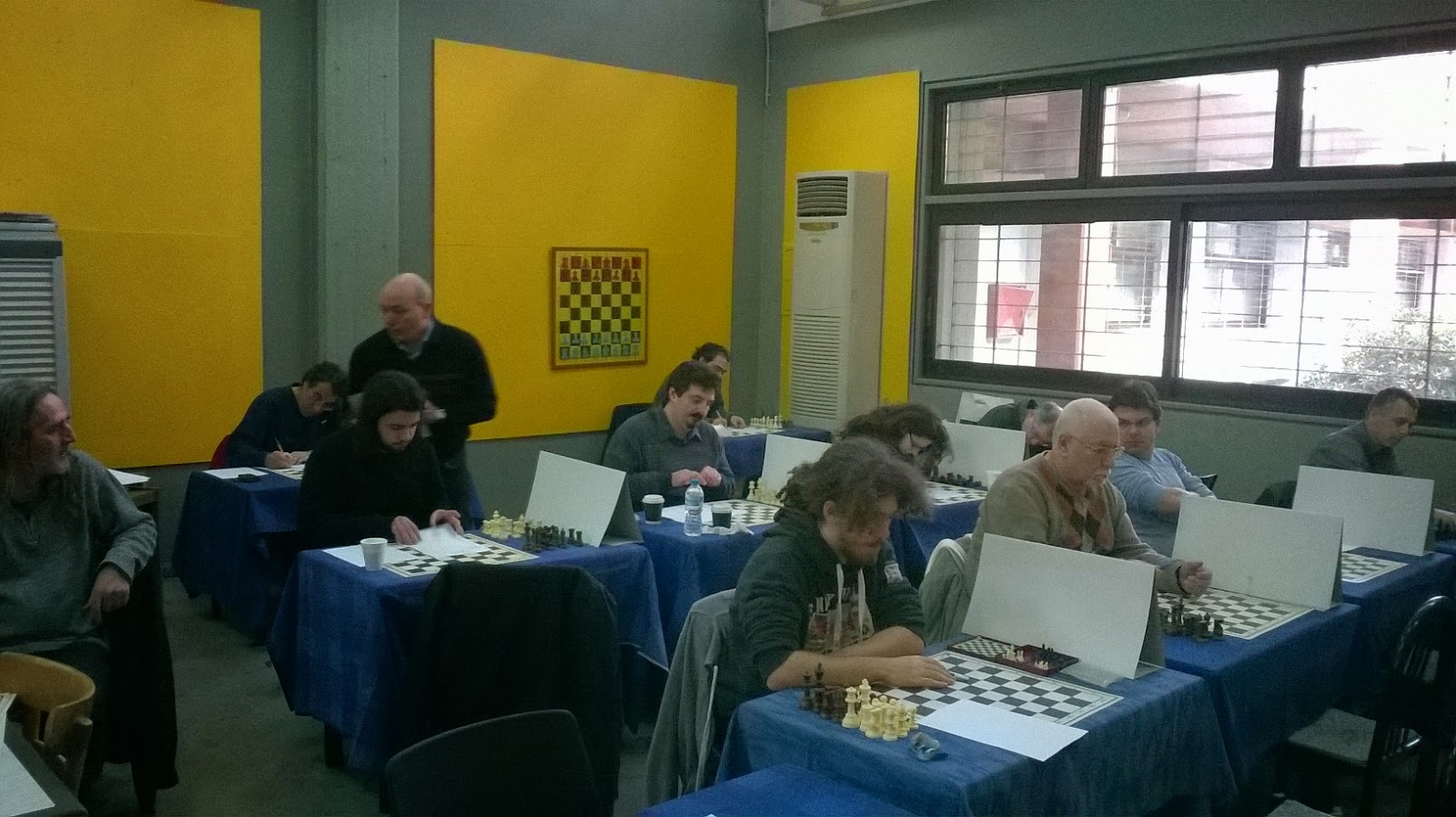
 | The judge Giannis Garoufalidis, Anastasis Papargyriou, Andreas Papastavropoulos, Nikos Mendrinos FIDE Maitre |
Tuesday, January 28, 2014
Problems and Results of ISC 2014
Update 24-II-2014 : Final results : http://www.matplus.net/isc.php
Category 2 : http://www.matplus.net/isc.php?px=1390923073&f=v&g=1
Category 2, 1st round, 2nd round
Results
Category 1 : http://www.matplus.net/isc.php?px=1390922393&f=v&g=0Category 2 : http://www.matplus.net/isc.php?px=1390923073&f=v&g=1
Problems
Category 1, 1st round, 2nd roundCategory 2, 1st round, 2nd round
Sunday, December 29, 2013
10th International Solving Contest
The 10th International Solving Contest, for 2014, is announced
http://www.wfcc.ch/competitions/solving/isc14inv/
http://www.wfcc.ch/competitions/solving/isc14inv/
Monday, January 28, 2013
ISC-9, Compositions solved and some results
Results from Athens, Greece :
First group, 60 points maximum :
1) Vaggelis Petridis, 17 points,
2) Harry Fougiaxis, 16,5
3) Emmanuel Manolas, 16,5
4) Leocratis Anemodouras, 7,5
5) Dimitrios Efthimakis, 4
Second group, 40 points maximum :
1) Dionissis Hassalevris
2) Panagiotis Papantoniou
See here the results from Patra, Greece.
First group, 60 points maximum :
1) Vaggelis Petridis, 17 points,
2) Harry Fougiaxis, 16,5
3) Emmanuel Manolas, 16,5
4) Leocratis Anemodouras, 7,5
5) Dimitrios Efthimakis, 4
Second group, 40 points maximum :
1) Dionissis Hassalevris
2) Panagiotis Papantoniou
See here the results from Patra, Greece.
12 Problems for the first group
| Problem-670 David Shire, Christopher Reeves, Marjan Kovačević, Original for The Problemist 2013 (version for 9. ISC) |
 #2 |
| Tries : {1.Sg5? [2.Sd3#] Sxa7 / Sd6 / Rxf1,Rxc1,Re3 2.Qxc3# / Qd4# / Qe3#, 1… Sf3 / Bf4 2.Sxf3# / Qxf4#, 1… b6!}, {1.Sc5? [2.Sd7#] Sd4 2.S1d3#, 1… cxd2!}, {1.Sd6? [2.Sc4#] exd5 / Sa3,Sxd6 2.Sd3# / Qd4 #, 1... Re4!} Key: 1. Sf2! (5) [2.Sg4#] f5 / Re4 2.Scd3# / Sfd3# Shows auto-blocks and contains theme Somov B2. |
| Problem-671 A.N. Pankratiew, V.N.Rychkow, Yourij Marker, The Problemist 1990 |
 #3 |
| Tries : {1.Rxa4+? Kb5!}, {1.Be2+? Sxe2!}, {1.Rc5+? dxc5!}, {1.Bxd5+? Sxd5!}, {1.b3+? axb3+!} Key : 1. Qh3! [2.Rxa4+ (1) Kb5 3.Qxd7#] 1… Sg4,Sef5 2.Be2+ (1,5) Sxe2 / Kxd4 3. Qd3# / Rxd5 # 1… Sgf5 2.Bxd5+ (1,5) Sxd5 / Kxd4 3.Qd3# / Re4 # 1… Kxd4 2.Qh8+ (1) Kc4 3.Qc3 # |
| Problem-672 Heinz Gfeller, Schweizerische Schachzeitung 1966 (dedicated to K. Flatt) |
 #7 |
| Tries : {1.Ra5+? bxa5!}, {1.Bd5? / Ba5? / Bb4? Bb7!} Key : 1.Bc4! Kb7 2.Ba5 Kc6,Ka6 3.Bb4 Kb7 4.Bd5+ Ka6 5.Ra5+ bxa5 6.Bc5 (5) 1… … 2… a6? 3.Rxb6 Ka7 4.Bd5 Rb8 / Bb7 5.cxb8=Q# / Rxb7# Contains theme Kozhakin (First and last White move on the same square). |
| Problem-673 Martin Minski, Original for Magyar Sakkvilag 2013 |
 + (White wins) |
| 1.Kc7 (1) Rd5 (i) 2.c4 (1) (ii) Rxa5 3.b5+ (1) (iii) Ka7 (iv) 4.c5 (1) Ra6 (v) 5.a5 (1) bxa5/bxc5 6.b6+ +- (i) 1…Rh8 2.Sc6 b5 3.c4 +-, 1… Rd6 2.Sc6 b5 3.Sb8+ Ka7 4.axb5 +- 1…Rb8 2.Kxb8 bxa5 3.Kc7! axb4 4.cxb4 +- (ii) 2.Sc6? b5! 3.c4 bxc4 4.b5+ Rxb5 5.axb5+ Kxb5 = (iii) 3.bxa5? Kxa5 = (iv) 3...Rxb5 4.axb5+ Ka5 5.c5! bxc5 6.b6 c4 7.b7 c3 8.c8=Q +- (v) 4…Rxb5 5.axb5 bxc5 6.b6+ +-, 4…bxc5 5.b6+ Ka6 6.b7 +- |
| Problem-674 Jozsef Pogats, idee und form 1996 |
 h#4, 4 solutions |
| I) 1. Sd2 Kxd2 2. Ke4 e3 3. Rf5 Bxa6 4. Be5 Bxb7 # II) 1. Sd3 exd3 2. Rd5 Be2 3. Rd6 Bg4 4. Bd5 d4 # III) 1. Sf3 Kd3 2. Kf4 Bxg2 3. Rg5 Bxh3 4. Be5 e3 # IV) 1. Bf3 exf3 2. Qc2 Bb5 3. Qg6 f4+ 4. Kf5 Bc6 # [ 1 solution=1 point, 2 s=2,5 p, 3 s=4 p, 4 s=5 p ] The Black King is mated on e5, f4 by the Pawn and on e4, f5 by the Bishop. There are preventive auto-blocks, Orthogonal - Diagonal Transformation and Model Mates. |
| Problem-675 Waldemar Tura, The Problemist 1985, 2nd Prize |
 s#3 |
| Tries (besides the 16 checking moves which result in undesirable mating of Black) : {1.Qb6+? Sxb6!}, {1.Ra8? Sc4!}, {1.Qg3? / Qf4? / Qb8? / Bc8? / Rg5? Qc1!} 1…Rb6 2.Sd5+ Kb5 3.Sxd4+ (1,5) Qxd4# 1…b3 2.Sd6+ Kb4 3.Sxc6+ (1,5) Rxc6# 1…Sc3,Sb6 2.Sxd4+ Sd5 3.Sb3+ (1) Qxb3# White and Black batteries in action. |
| Problem-676 Života Tanić, Die Schwalbe 1973, 1st Prize |
 #2 |
| Tries : {1.Sc3? d3!}, {1.Sxc5? Sxc5!}, {1.Sxg5? Se6!}, {1.Sc4+? Rxc4!}, {1.Rb5? Sc7!}, {1.Rf5+? gxf5!}, {1.Re8+? Se6!}, {1.Qe1? Sd3!}, {1.Qe3? b2!}, {1.Qxd4+? / Bxd4+? Rxd4!}, {1.Qf4+? gxf4!}, {1.Qxg5+? Rxg5!} Key : 1.Sf6! (5) [2.Sf7#] Se6 / Rh7 2.Qe3# / Qxg5# We see Levman defense : (The control of a square x of the black King field by a white piece is removed by the threat (which is not made by this piece). This is possible because a third white piece controls x (this control exists only after the threat). Black defends by removing this third control.). Here the control of f6 by the Rf8 is removed with the threat Sf7 because Rb6 can control then the f6. So, Black plays Se6. There is also theme Option, where at least two tries (with different defenses) and the key are performed with the same piece. |
| Problem-677 Carel Sammelius, Tidskrift for Schack 1955, 2nd Hon. Mention |
 #3 |
| Tries : {1.Be3+? Bxe3!}, {1.Sce2+? / Sge2+? dxe2!}, {1.Sb3+? axb3!}, {1.d8=Q? Rxd8!}, {1.Bf6? Rxh6!}, {1.Be7? / Bd8? c2!} Key : 1.Rh3! [2.Sce2+,Sge2+ (0,5) fxe2 3.Sxe2#] 1...Se~ 2.Bf6+ (1) Se5 3.Qf4# 1...Sxd7 2.Qg7+ (1) Se5 3.Qa7# 1...Sxc6 2.Qf6+ (1) Se5,Kc5 3.Qb6# 1...Sxg4 2.Qxh8+ (1) Se5 3.Rh4# 1...Sxc4 2.Rxc4+ (0,5) Kxd5 3.Qe6# We see swithbacks of bS and wR, reciprocal captures, self-blocks, direct and indirect pins. |
| Problem-678 Jakov Vladimirow, Vetchernij Leningrad 1988, 1st Prize |
 #4 |
| Tries : {1.Qxe4+? / Rxe4+? Qxe4!}, {1.Qxf4+? / Bxf4+? Qxf4!}, {1.Qg4? Qxg4+!}, {1.Qh5? Qxh5+!}, {1.Sg6+? hxg6!}, {1.Sxe7? / Bxh2? / Sh6? d5!} Key : 1.Bf7! Zugzwang 1...cxb5 2.Rxe4+ Qxe4 3.Bxf4+ (1) Qxf4 4.Qd5# 1... Bf8 / Bd6 / Bxc5 2.Bxf4+ Qxf4 3.Rxe4+ (1) Qxe4 4.Qxf6# 1... Sf1 2. Qxe4+ Qxe4 3. Sf3+ (1) Kf5 4. Sh6# 1… Sg4 2. Qxf4+ Qxf4 3. Sf3+ (1) Kf5 4. Sxe7 # 1… d6,Bd8 2. Bxh2 ~ 3. Sxf5 (1) Reciprocal captures, Orthogonal - Diagonal Transformation, White sacrifices. |
| Problem-679 Alexander Herbstman, Spartak 1962, 2nd Price |
 + (White wins) |
| 1.Bd4+ Kb1 2.Ra1+ Kc2 3.Ra2+ (1) Kd3 4.Ra3+ (1) (i) Ke2
5.Re3+ Kf2 6.Re4+ Kf1 7.Rf5 (1) Rf2 8.Kd6 (1) h2
9.Rh4 (1) +- (i) 4.Rxh2 Bxd5+ 5.Kd5 = /Kc5 Bg2 = |
| Problem-680 Christopher Jones, Original for ISC 2013 |
 h#3, 2 solutions |
| 1.Sd5 cxd5+ 2.cxd5 c6 3.Bxc6 Rxc6# (2,5) 1.Re3 fxe3 2.f2 Rxf2 3.e5 Bf7# (2,5) Self-blocks, Black sacrifices. |
| Problem-681 Peter Kniest, feenschach 1981 |
 s#4 |
| Tries (besides the 11 checking moves which result in undesirable mating of Black) : {1.Re6+? / Qe7+? Kf5!}, {1.Qb5+? / Qxh7? Kxd6!}, {1.Rdh6? / Ra6? / Rb6? / Rc6? / Rg6? / g6? / Ba2? / Bb3? / Be6? / Bf7? Sf8!} Key : 1.Rf6! Sxg5 2.Rh5 Kxf6 3.Rh6+ Ke5 4.Sxf3+ (1,5) Sxf3# 1...Sf8 2.Qe7+ Se6 3.Qc5+ Sxc5 4.Sxd3+ (1,5) Sxd3# 1...Sxf6 2.Sg4+ Sxg4 3.Sc4+ Ke4 4.Bd2 (2) f2# Sacrificial key, model mates. |
8 Problems for the second group
| Problem-682 Arieh Grinblat, Probleemblad 1989, 149 TT, 1st Prize |
 #2 |
| Tries : {1.Sf4+? Sxf4!}, {1.Se7+? Sxe7!}, {1.Bxb6? Sf4!}, {1.Bxb5? axb5!}, {1.Bc6+? Bxc6!}, {1.Bf7? Bc8!}, {1.Qb1? / Qd1? c2!}, {1.Qa2? b4!}, {1.Qxa6? Rxa6!}, {1.b4? Kc4!}, {1.f4? Sg3!}, {1.e7? Sh6!} Key : 1.Qh1! (5) [2.f4#] Sg3,Sf4 2.Sf4# Theme Laitinen : (White threatens of a chechmate by battery of Pawn. The Blacks defends playing on the square where the Pawn threatens to move.). |
| Problem-683 Herbert Kuechler, Schach 1961, 2nd Prize |
 #2 |
| Tries : {1.Bxd4? Rxh4!}, {1.Rxg4+? Bxg4!}, {1.Re1+? / Re2+? / Re4+? Kxg5!}, {1.Ra5+? / Rb5+? / Rd5+? Ke3!}, {1.Re6+? / Re7+? / Re8+? / Qc1+? Kxg5!} Key : 1.Qf7! (5) [2.Qxf5#] 1...Rxg5 2.Re4 # 1...Bxe5 2.Rxg4 # 1...Kxe5 2.Bb8 # 1...Kxg5 2.Rxg4 # Self-block, pin mate. |
| Problem-684 Martin Minski, Original for Šachová skladba 2013 |
 + (White wins) |
| 1.Se6+ (2) (i) Bxe6 (ii) 2.Rd3 (1) Qc7 3.Bg3 (1) Qa5
4.Sc6 Q~ 5.Rd8+ (1) +- (i) 1.Rd3? Qxc7 2. Bg3 e5! = (ii) 1… fxe6 2. Rf3+ +- Pseudo-sacrifice of the white Knight. |
| Problem-685 Carel Sammelius, Probleemblad 1973, 3rd Hon. Mention |
 s#2 |
| Tries : {1.Rxe4+? Sxe4!}, {1.Qc1+? Sd2!}, {1.Qf2+? Kd2!}, {1.Qxc3+? Sxc3+!}, {1.fxg4? Rxg4!} Key : 1.f4! [2.Qxc3+ (0,5) Sxc3#] 1...Sc~ 2.Qd2+ (0,5) Sxd2# 1...Sa3 2.Qc1+ (1) Rxc1# 1...Sd2 2.Qg1+ (1) Rxg1#,hxg1=~# 1...Sxe2 2.Qg3+ (1) Sxg3# 1...Sd1 2.Qf2+ (1) Sxf2# Theme Cristoffanini (Black pins the threatening white piece which mates nevertheless). Move Pelle (of a pinned piece), white sacrifice, recoprocal captures, masked black battery, pin mate. |
| Problem-686 Hrvoje Bartolovic, Suomen Shakki 1991, 2nd Prize |
 #2 |
| Tries : {1. Bd3? / Be4? / Bf5? / Bxg6? b5! / bxa6! / exf5! / Qxg6!} {1. Rb4? / Rb5? / Rb6? / Rxb7 / Ra2? a3! / fxe6! / Qf8! / Qf8! / b5!} {1. Re1? / Rf1? f5! / f3!} Key : 1.Rh1! (5) [2.Qg1#] f3 / c3 2.Rh4# / Rb4# Theme Bristol. Theme Option. |
| Problem-687 Yosi Retter, TT Denmark 1988/89, 1st Prize |
 #2 |
| Tries : {1.Se2+? Bxe2!}, {1.Sb5+? Sxb5!}, {1.Sd5+? Rxd5!}, {1.Bb2+? Kb4!}, {1.Bb4+? cxb4!}, {1.Ba2? S2e4!}, {1.Ba6? S6e4!}, {1.Bf1? / Be2? Be4!}, {1.Bd5? / Be6? / Bf7? / Bg8? Re4!}, {1.Rb3+? Sxb3+!} Key : 1.Bd3! (5) [2.Bb2#] 1...Re4 / S2e4 / S6e4 / Be4 2.Sd5# / Rb3# / Sb5# / Se2# Theme Elmgren (All black pieces refute a Try). Theme Anti-Somov A1. |
| Problem-688 A.W.Galitzky, Schachmatnoje ob. 1903 |
 #3 |
| Tries : {1.Qxa4+? bxa4!}, {1.Rxc1? Rxc1!}, {1.Qf8? / Bxb5? Rxb2+!}, {1.Re1? / Rh1? Bd2!}, {1.b4+? Bb2!}, {1.Bf6? / Bg7? Bxb2!} Key : 1.Bh8! Zugzwang 1…Bxb2 2.Rh1 (2) 1…Rxb2+ 2.Qg2 (2) 1… Bd2,Be3,Bxf4 2.b4+ (1) Theme Grab, with multiple application. Bicolour Bristol, reciprocal captures, model mates. |
| Problem-689 Valerio Agostini, harmonie 2010, 6th Hon. Mention |
 h#2, 2 solutions |
| I) 1.Kd4 Ba6 2.Rfe4 Kc8# (2,5) II) 1.Kf5 Rg8 2.Ree4 Kd8# (2,5) Orthogonal - Diagonal transformation, White royal battery, indirect self-pin, pin mate, self-block. |
Monday, January 30, 2012
International Solving Contest 2012
The Greek results of the International Solving Contest (ISC), which is usually held on the last Sunday of January, were sent by the coordinator mr Ioannis Garoufalidis.
There were two categories, the first (more difficult) with 12 problems and the second with 8 problems.
The contest for Greece took place simultaneously in Athens and in Patras. The following list does not discriminates locations.
First Category
Other solvers follow Efthimakis D, Spyropoulos G, Skyrgianoglou D, Betsos T, Petridis E, Manolas E, Hararis D.
Second Category
Other solvers follow Gouvas S, Malataras G, Betsos N, Triantos K.
The problems of the contest:
8. INTERNATIONAL SOLVING CONTEST, 29 JANUARY 2012
CATEGORY 1 - SOLUTIONS
8. INTERNATIONAL SOLVING CONTEST, 29 JANUARY 2012
CATEGORY 2 - SOLUTIONS
There were two categories, the first (more difficult) with 12 problems and the second with 8 problems.
The contest for Greece took place simultaneously in Athens and in Patras. The following list does not discriminates locations.
First Category
| Fougiaxis H | 23,5 |
| Anemodouras L | 22 |
| Konidaris P | 20,5 |
Other solvers follow Efthimakis D, Spyropoulos G, Skyrgianoglou D, Betsos T, Petridis E, Manolas E, Hararis D.
Second Category
| Leftheriotis E | 15 |
| Asvestopoulos X | 14 |
| Athanasopoulos K | 13 |
Other solvers follow Gouvas S, Malataras G, Betsos N, Triantos K.
The problems of the contest:
8. INTERNATIONAL SOLVING CONTEST, 29 JANUARY 2012
CATEGORY 1 - SOLUTIONS
| 1 | Aleksandr Pankratiev, Clube Xadrez Belo Horizonte 50JT 1990-2, 1.-3.Pr. 1.Bg1? (2.S3xc4#) Kxe5 2. Qxf6 # 1. … Sc2! 1. Qxf6? (2.Sd7#) Kc5 2. Sd3 # 1. … Sc6! 1.Sd3! (5) thr./Kxe3 2. Qc5/Bg1 # | ||
 | |||
| #2 | (10+10) | ||
| 2 | Don Smedley, Observer 1989-90, 1. Pr. . 1.Bg8! dr. 2. f7 (1) 1. … Rc2,Rc1 2. Rxe5+ (0,5) Kxe5 3. Qxe3 # 1. … Sa4 2. Rxe5+ (0,5) Kxe5 3. Qxe3 # 1. … Sxc4 2. Rd4+ (0,5) Kxd4 3. Qxc4 # 1. … Rxc4 2. Sd6+ (0,5) Kd4 3. Qxc4 # 1. … Rd3 2. Rxd3 (0,5) Sxd3 3. Sd6 # 1. … Sd3 2. Rxd3 (0,5) Rxd3 3. Rxe5 # 1. … Sf7 2. Bxf7 (0,5) Bxg4 3. Qxg4 # 1. … Bf1 2. Qxf1 (0,5) - 3. Qh1,Qg2/Qf4 # | ||
 | |||
| #3 | (12+11) | ||
| 3 | Norman MacLeod, Hans Peter Rehm, Die Schwalbe 1989, 2. HM 1. Kh3? c4! 2. Kg2 Qc5! 1. Kg2? Sc4! 2. Kh3 Sxe5! 1.Rf7! dr. 2. fxe6# 1. ... Rf8 2. Kg2 Sc4 3. Kh3 (2,5) Sxe5 4. Bxh6 # 1. ... exf5 2. Kh3 c4 3. Kg2 (2,5) Qc5/d4 4. Rfxf5/Re4 # | ||
 | |||
| #4 | (8+14) | ||
| 4 | Oscar J. Carlsson, Mundo de Ajedrez 1975 1. Sb1 (1) (i) Rc8 (ii) 2. Sg8 (1) d4! 3. Bxd4 g1Q! (iii) 4. Bxg1 Rxc2! 5. Kg4!! (1) (iv) Rg2+ 6. Kf3! (1) Rxg8! 7. hxg8B! Kxg1 8. Bc4 (1) (v) +- (i) 1. h8Q? b1Q 2. Qg8 Qf1 -+; 1. Sg4? g1Q 2. Bxg1 b1Q 3. Sxb1 Kxg1 4. c3 Bxc3 = (ii) 1. ...d4 2. h8Q g1Q 3. Qa8+ +- (iii) 3. ... Rxc2 4. Bg1! Rc3+ 5. Kg4 Kxg1 6. h8Q +- (iv) 5. h8Q? Rh2+! 6. Bxh2 = 5. Kg3? Rh2! = ; 5. Kh4? Kxg1 6. Kg5 Rg2+ 7. Kf6 Rh2 = (v) 8....Kh2 9. Bf1 Kg1 10. Ke2 Kh2 11. Kf2 Kh1 12. Sd2 b1Q 13. Bg2+ Kh2 14. Sf3 # | ||
 | |||
| + | (6+6) | ||
| 5 | P. Makarenko, Aleksandr Pankratiev, The Problemist 1990, 1. HM I) 1.Bd4 Kb4 2. Bxe3+ Kxc3 3. Bd4+ Kb4 4. Re5 Kb5 5. Rge4 c4# (2,5) II) 1.Rg8 Ka4 2. Rxe3 Kb3 3. Re5 Kxc3 4. Rc8 Kd3 5. Rc6 c4# (2,5) | ||
 | |||
| h#5 | 2 solutions | (3+8) | |
| 6 | Friedrich Chlubna, Klaus Wenda, feenschach 1983, 1. Pr. 1. Ra4? (2.Ba2) Rd8! 1. Ra3? (2.Ba2) e5! 1. Be5? Bg6! 1.Kf1! dr. 2.d3 dr.,Rxf8 3.Sd4+ (1) Bxd4# 1.... ... 2.... dr.,Bg6,e5 3.Se3+ (1) Bxe3# 1.... Rxf8 2.Se3+ Ke6 3.Sf5+ (1) Be3# 1.... Bg6 2.Sd4+ Kxf6 3.Sde6+ (1) Bd4# 1.... e5 2.Se1+ e4 3.Rxa5+ (1) Bc5# | ||
 | |||
| s#3 | (15+10) | ||
| 7 | Liew Chee Meng, The Problemist 1985-I, 3. Pr. 1. Re4? Rd5! 1. Se5? Rd4! 1.Sb8! (5) dr. 2. Sd7 # 1. ... Be5, Rd5 2. R(x)d5 # 1. ... Re4, Bd3+ 2. S(x)d3 # 1. ... Rd4, Be4 2. Q(x)d4 # 1. ... Rg7 2. Rd5 # 1. ... Re5 2. Qf8 # | ||
 | |||
| #2 | (10+9) | ||
| 8 | Carel Sammelius, Schweizerische Arbeiterzeitung 1980-1, 1. Pr. 1.Bg3! dr. 2. Qa3+ (1) Rd3/Bd3 3. Qe7/Qc1 # 1. ... Rd1 2. Qb3+ (1) Rd3/Bd3 3. Qe6/Qxb6 # 1. ... Bc4 2. Qc3+ (1) Rd3/Bd3 3. Qe1/Qd2 # 1. ... Qh2,Qh7,Qg7,Qf8 2. Rxf3+ (1) Kxf3 3. Qf4 # 1. ... Qxf4 2. Bxf4+ (1) Kd3 3. Rd2,Qc4 # | ||
 | |||
| #3 | (5+10) | ||
| 9 | Dieter Kutzborski, Stefan Eisert, Saechsische Zeitung 1980, 2. Pr. 1. Sf6? Bxh3! (2. Rf5??) 1. Kb2! (dr. 2. Bd7+ Kd5 3. Sf6+ Kxc4 4. Bb5 #) 1. ... bxa3+! 2. Kb3 Rxh3+ 3. Rf3! Rh5! 4. Sf6 Bh3 5. Rf5 (5) Rxf5/Bxf5 6. Bd7/Bd5 # 1. ... d3 2. Bd7+ Kd5 3. Rf4 (5#) | ||
 | |||
| #6 | (10+8) | ||
| 10 | Siegfried Hornecker, Original 1. Rh1+ (1) (i) Kg2 2. Ba7! (1) (ii) Kxg3 3. Bxd4 Kg2 4. Rh4!! (1) (iii) e2+ 5. Ke1 b2 (iv) 6. Rg4+ Kh3 7. Bxb2 (1) axb2 (v) 8. Rb4 Kg2 9. Rg4+ (1) Kh3 10. Rb4 = (i) 1. Se2+? fxe2+ 2. Kxe2 b2! 3. Rh3 b1Q 4. Rg3+ Kh2 5. Rxe3+ Qxb8 -+ (ii) 2. Be5? d3! -+ (iii) 4. Rh8? e2+ 5. Ke1 (5. Kd2 e1Q+ 6. Kxe1 f2+ 7. Bxf2 b2 -+) f2+ 6. Bxf2 b2 7. Kxe2 b1Q 8. Rg8+ Kh3 9. Rh8+ Kg4 10. Rg8+ … Kh7 -+ (iv) 5… f2+ 6. Bxf2 b2 7. Kxe2 b1Q 8. Rg4+ Kh3 9. Rh4+ = (v) 7. ... Kxg4 8. Ba3 = | ||
 | |||
| = | (4+6) | ||
| 11 | Christer Jonsson, The Problemist 1991 I) 1. Ke4 Bg3 2. Rh3 Bb8 3. Rd3 Rf4 # II) 1. e6 Be7 2. Sg3 Bc5 3. Se4 f4 # III) 1. Sf3 Bg5 2. Sd4 f3 3. e6 Bf4 # (1 sol = 1 pt; 2 sol = 3 pts; 3 sol = 5 pts) | ||
 | |||
| h#3 | 3 sol. | (4+8) | |
| 12 | Bertil Gedda, Stella Polaris 1972, 1. Pr. 1.Qa7! 1.... g3 2.Bf8 g2 3.Se7+ Kd6 4.Seg6+ Kc6 5.Se5+ (2,5) Sxe5 # 1.... gxh3 2.Ra3 bxa3 3.b4 cxb4 4.Kb3 Kb5 5.Sd4+ (2,5) Sxd4# | ||
 | |||
| s#5 | (11+6) | ||
8. INTERNATIONAL SOLVING CONTEST, 29 JANUARY 2012
CATEGORY 2 - SOLUTIONS
| 1 | Herbert Ahues, Thema Danicum 1991, 1. Pr. 1. Bb6? S2e4! 1. Bxe3? S6e4! 1. Bd4? Qc8! 1. Bb4? Sb5! 1. Ba3! (5) dr./S2e4/S6e4/Qc8/Sb5/Bxd5/Qd4 2. Rc5/Sb6/Sxe3/Rd4/Ra4/Bxd5/Rxd4 # | ||
 | |||
| #2 | (9+11) | ||
| 2 | Lev Loshinski, L’Italia Scacchistica 1930, 1. HM 1.Rb1! (5) dr. 2. d4 # 1. … Bg4/Rg4 2. Bg1/Se6 # 1. … Re6/Be6 2. Sd7/Bd6 # 1. … Rb2/Bb2 2. Qxc3/Qf2 # 1. … Rd6 2. Bxd6 # | ||
| |||
| #2 | (10+8) | ||
| 3 | Mike Brent, Schweizerische Schachzeitung 1987-88, Comm. 1 1.Sd4+ (1) Sxd4 2. Kf8 (1) Kf6 3. e8S+ (1) (3. e8Q? Se6+ -+) Ke6 4. Sxc7+ Kd7 5. Se8 (1) (5. Sa6? Se6+ -+) Se6+ 6. Kf7 Sc7+ 7. Kf8 (1) Sxe8 = | ||
 | |||
| = | (3+4) | ||
| 4 | M Limbach, The Problemist 1988, 2. Pr. 1. Rde1? Qd5! 1.Ba2! (1) 1...... thr. 2.Se3+ (1) Sxe3# 1...... Qe4 2.Rf7+ (1) Sf6# 1...... Qa7,Qb6 2.Rd5+ (1) Se5# 1...... Sg2 2.hxg4+ (1) Rxg4# | ||
 | |||
| s#2 | (8+13) | ||
| 5 | Norman MacLeod, Springaren 1988, 3. HM 1. Sc6/Sd7/Sf7/Sg6/Sf3? Sxb5/dxc5/Be3/Rxh8/Bf6 ! 1. Sg4! (5) dr. 2. c4 # 1. … Sxb5/dxc5/Rxh8/Bf6 2. Qxa8/Qd8/Qxg5/Sxf6 # | ||
 | |||
| #2 | (12+8) | ||
| 6 | Norman MacLeod, Mat 1988, 1. Pr. 1. Sf7? S4-! 1. Sc8/Se8/Sdc4/Sb5? S4g6/Sh5/Sg2/Se2 ! 1. Se4? Kxd4! 1. Sf5? cxd4! 1. Sdb7! (5) dr./S4-/ S8g6/Sd7/ Kxd4/cxd4/Rd6 2. Qe5/Qxc6/Qxd8/Qd6/Rd1/ Rg5/ Qxd6 # | ||
 | |||
| #2 | (8+11) | ||
| 7 | L. Makaronez, The Problemist 2008 1.Sf6! (0,5) d6 2. Kc7 (1,5) d5 3. Sd7 # 1. … d5 2. Sg8 (1,5) Kd6 3. Qe7 # 1. ... Kd6 2. Qe1 (1,5) Kc5 3. Qb4 # | ||
 | |||
| #3 | (5+2) | ||
| 8 | Attila Benedek, The Problemist 1991 I) 1. Qc5 Sb4 2. Kd4 Re4 # II) 1. Qd2 Re4+ 2. Kd3 Sb4 # III) 1. Kd3 Sf3 2. Qc4 Sde1 # (1 sol = 1 pt; 2 sol. = 3 pts ; 3 sol = 5 pts) | ||
 | |||
| h#2 | 3 solutions | (4+3) | |
Sunday, January 23, 2011
Results of ISC-7
(Update 12.02.2011)
Final results from Greece (A from Athens, P from Patras) for the seventh International Solving Competition :
First Category
A 01. Fougiaxis Harry 27.5/60 (235' minutes)
A 02. Manolas Emmanuel 14.5 (240')
P 03. Spyropoulos Giorgos 11.5 (152')
P 04. Betsos Titos 11.5 (237')
P 05. Spiliadis Athanasios 6.0 (240')
A 06. Petridis Evangelos 6.0 (240')
P 07. Mauromati Aggeliki 5.0 (210')
P 08. Lefteriotis Emilios 5.0 (230')
P 09. Kotrotsos Nikodimos 5.0 (230')
P 10. Athanasopoulos Kyriakos 5.0 (232')
P 11. Stamatopoulos Giorgos 5.0 (233')
P 12. Iliopoulos Alexis (240')
See a post, with problems and solutions, by Tassos Alexandrou from Patras here.
Our friend Alotan sent a link http://www.matplus.net/pub/isc.php?px=1295891472, where Mr Velimirovic in the Mat Plus forum presents nicely problems, solutions and statistics. Leading solver in the world is Mr John Nunn (ELO 2773).
From Greece, leading in the first category (No.92 in the world ladder) is Mr Harry Fougiaxis (ELO 2084).
Final results from Greece (A from Athens, P from Patras) for the seventh International Solving Competition :
First Category
A 01. Fougiaxis Harry 27.5/60 (235' minutes)
A 02. Manolas Emmanuel 14.5 (240')
P 03. Spyropoulos Giorgos 11.5 (152')
P 04. Betsos Titos 11.5 (237')
P 05. Spiliadis Athanasios 6.0 (240')
A 06. Petridis Evangelos 6.0 (240')
P 07. Mauromati Aggeliki 5.0 (210')
P 08. Lefteriotis Emilios 5.0 (230')
P 09. Kotrotsos Nikodimos 5.0 (230')
P 10. Athanasopoulos Kyriakos 5.0 (232')
P 11. Stamatopoulos Giorgos 5.0 (233')
P 12. Iliopoulos Alexis (240')
See a post, with problems and solutions, by Tassos Alexandrou from Patras here.
Our friend Alotan sent a link http://www.matplus.net/pub/isc.php?px=1295891472, where Mr Velimirovic in the Mat Plus forum presents nicely problems, solutions and statistics. Leading solver in the world is Mr John Nunn (ELO 2773).
From Greece, leading in the first category (No.92 in the world ladder) is Mr Harry Fougiaxis (ELO 2084).
Monday, January 10, 2011
7th International Solving Contest (ISC)
7th International Solving Contest (ISC)
Sunday January 23rd 2011
The next International Solving Contest will take place on Sunday January 23rd 2011. The event is happening simultaneously in all participating countries.
There will be two sections: one for the experienced solvers. In this section solvers can obtain rating points.
The second section is intended for weaker, inexperienced solvers and for youth.
The delegates have to appoint a local controller who can be trusted on the responsible task of organizing this contest in your country. If you find it appropriate this contest may be organized in more than one location in your country. But for each location a local controller must take the responsibility. It is absolutely required that the local controller must dispose of an e-mail address. The delegate will thus indicate this e-mail-address.
The contest will consist of two rounds with six problems each, i.e. for each round a 2#, 3#, n#, EG, h# and s#.
For each round, the solving time is two hours.
To prevent possible irregularities it is essential that the start of the contest must be at the same time in each country. This means CET (Central European Time) at 11 hr. Local time must meet this CET. Between the two rounds a break is foreseen of minimum 0,5 hr and max 1,5 hr, at the option of the local controller.
more details ==> http://www.saunalahti.fi/~stniekat/pccc/isc11inv.htm
Sunday January 23rd 2011
The next International Solving Contest will take place on Sunday January 23rd 2011. The event is happening simultaneously in all participating countries.
There will be two sections: one for the experienced solvers. In this section solvers can obtain rating points.
The second section is intended for weaker, inexperienced solvers and for youth.
The delegates have to appoint a local controller who can be trusted on the responsible task of organizing this contest in your country. If you find it appropriate this contest may be organized in more than one location in your country. But for each location a local controller must take the responsibility. It is absolutely required that the local controller must dispose of an e-mail address. The delegate will thus indicate this e-mail-address.
The contest will consist of two rounds with six problems each, i.e. for each round a 2#, 3#, n#, EG, h# and s#.
For each round, the solving time is two hours.
To prevent possible irregularities it is essential that the start of the contest must be at the same time in each country. This means CET (Central European Time) at 11 hr. Local time must meet this CET. Between the two rounds a break is foreseen of minimum 0,5 hr and max 1,5 hr, at the option of the local controller.
more details ==> http://www.saunalahti.fi/~stniekat/pccc/isc11inv.htm
Sunday, January 24, 2010
Solving Contest 2010-01-24, ISC 6
Sixth International Parallel Solving Contest
The Greek announcement : here. In Athens Greece, Sunday January 24, 2010. Organiser : Harry Fougiaxis, email: harryfou@ath.forthnet.gr
Greek solvers in category-1 :
Kostas Prentos, Panagiotis Konidaris, Philip Terzis, Athanassios Spiliadis, Apostolos Stamatopoulos, Constantinos Smpoukis, Giorgos Finokaliotis, Nikodimos Kotrotsos, Giorgos Stamatopoulos, Emilios Lefteriotis, Clelia Lykothanassi, Emmanuel Manolas.
Congratulations to the Greek champion Kostas Prentos (from Thessaloniki), to Panagiotis Konidaris (from the island Meganissi near Lefkada), to Philip Terzis (from Patras).
We present now the problems of the contest, first the 8 of the easy category-2 and then the 12 of the more difficult category-1.
Category 2
Set play 1...Qxa1,Qa2 / b2 / Sa5 2.Sc2# / Qd1# / Bb5#
Tries [1.Qc4? b2!], [1.Qe4? Sc5!]
Key 1.Qd4! (5) ( > 2.Qd7# )
1...Qxa1,Qa2 / b2 / Sa5 / Sc5 / Sd6,Sd8
2.Sc2# / Qd1# / Bb5# / Sc6# / Qa7#
Key : 1.Qc2! (5) Zugzwang
1...d5 / Saxc2 / Sbxc2 / d3 / e2 / f4
2.Qc7# / Sc4# / Sd3# / Qc3# / Qxe2# / Qe4#
Key : 1.b7! (1) Sd6+ 2.Kd4! (1) [i] Sxb7 3.Kd5! (1) Kg7 [ii] 4.Sd8! (1) Sxd8 5.e7! (1) Sf7 6.e8Q +
[i] 2.Kd5? Sxb7!
[ii] 3...Sc5 4.e7 Se6 [iii] 5.Kd6 Sg7 6.Kd7 Kf7 7.Sd8+ K~~ 8.Se6
[iii] 4...Sa6 5.Kd6 Kf7 6.Sd8+ Ke8 7.Se6 Kf7 8.Sg7 Sc7 9.Kd7 Kf6 10.Se8+
Set play 1...Se6 / Sxh5 / Se8 2.Qxe6 / Qh2 / Qxe8 d2,f2#
Key : 1.Bh7! Zugzwang
1...Se6 2.Qxe6 (1,25) d2,f2#
1...Sf5 2.Bxf5 (1,25) d2,f2#
1...Sxh5 2.Qxh5 (1,25) d2,f2#
1...Se8 2.Qb8 (1,25) d2,f2#
Set play 1...Kc5 / Ke3 2.Sed3# / Sg4#
Try [1.Qh4? ( > 2.Qf2# ), 1...Kc5 / Ke3 2.Sfd3# / Sg2#, 1...Sd6!]
Key : 1.Qg5! (5) ( > 2.Qg1# )
1...Kc5 / Ke3 / Sd6 2.Sc6# / Se6# / Bb6#
Tries [1.Be5? Sxh7!], [1.Rd4? Re6!], [1.Sd4? Re7!]
Key : 1.Bd4! (5) ( Novotny, > 2.Sg7#,Rd8# )
1...Rxd4 / Bxd4 / Re7,Se6 2.Sg7# / Rd8# / R(x)e7#
Key : 1.Sd5! ( > 2.Qd3+ (1,25) Ka4 3.Bc2#)
1...Bxe3+ 2.Sd4 (1,25) ( > 3.Qb3# ) Sc5 / a4 3.Sc2# / Qd3,Qb4#
1...Qxe3+ 2.Sb6 (1,25) ( > 3.Qa4# ) Sc5 3.Sc4#
1...Sc5 2.Qxa5+ (1,25) Sa4 / Kb3 3.Qb4# / Qb4,a2#
I) 1.Sd3! Bh2 2.Be3 Bxe5# (2,5)
II) 1.Se3! Qb3 2.Rf3 Qxd5# (2,5)
Category 1
Tries [1.Rc2? Rh4!], [1.Rc3? Rd3!], [1.Rc4? Rd5!], [1.Rc7? Qh6!]
Key : 1.Rc1! (5) ( > 2.Bf4# )
1...Rxc1,Rd5 / Rd3 / Rh4 / Qh6 / Sc3,Sc5
2.Q(x)d5# / Qxd3# / Qxd1# / Qb8# / Qb6#
Key : 1.Qg2! ( > 2.Qxd5+ (1,25) Sxd5 3.Sc5# )
1...Re4 2.Qg5 (1,25) ( > 3.Qf6# ) S~~ / Sd7 3.Sc5# / Qe7#
1...Rd7 2.Qg7 (1,25) ( > 3.Qxf6# ) S~~ / Se4 3.Sc5# / Qe5#
1...Se4 2.Qxe4+ (1,25) Rxe4,dxe4 3.Sc5#
Tries [1.Sf3+? Kxh3!], [1.f6? Sg6!], [1.Be5? dxe5!]
Key : 1.Bd4! ( > 2.Bxf2# )
1...Ra2 2.Be5 ( > 3.Bg3# )
__2...dxe5 3.f6 ( > 4.Sf3+ Kxh3 5.Bd7# )
____3...Sf7 4.Bxf7 ~~ 5.Sf3+ (*) Kxh3 6.Be6#
____3...Sg6 4.Bxg6 ~~ 5.Sf3+ (*) Kxh3 6.Bf5#
With one * = 4 points. With two * = 5 points.
1.Sc3+ [i] Kf4 2.Sd5+ Ke4 3.Sf6+ Kf4 4.Sxh5+ (1) Kg4 5.Sf6+ Kf4
6.Sd5+ Ke4 7.Sc3+ Kf4 8.Se2+! (2) Kg4 [ii] 9.Rxc8! (1) Bf5+ 10.Ke7 Bxc8
11.Kd8 Bf5/Ba6 12.Sd4! (1) +
[i] 1.Rxc8? Bf5+!
[ii] 8...Ke4? 9.Sg3+! ~~ 10.Rxc8.
I) 1.Qa7! Rb2 2.Kxf5 Rxb7 3.Kf6 Rb3 4.Qe7 Rf3# (2,5)
II) 1.Qb2! Re2 2.Kxh5 Rxe5 3.Kxh6 Re3 4.Qg7 Rh3# (2,5)
Key : 1.Re8! Zugzwang
1...exf6 2.Qxd5+ Kxd5 3.Sc3+ Kc6 4.Sd4+ (2,5) Sxd4#
1...d4 2.Bb7+ Kxb7 3.Sc5+ Kc6 4.Sxd4+ (2,5) Sxd4#
Set play 1...Kxe5 2.Qe3#
Tries [1.Qb6? Qd5!], [1.Qd1? / Qd4? d5!]
Key : 1.Qg6! (5) ( > 2.Qxe8# )
1...Bxf6 / dxe5 / Kxe5 / R~~
2.Qxf6# / Rb6# / Re3# / R(x)e7#
Key : 1.Sh3! Zugzwang
1...d2 2.Qxd2 (1) ( > 2.Qxc3# ) cxd2 / Kf6 3.Bb2# / Qg5#
1...Se3 2.Bxe3 (1) ~~ 3.Qg5# / Qd4# / Bf4# / Bd4#
1...h4 2.Sf2 (1) ~~ 3.Sg4# / Sxd3#
1...c6 2.Qxb8 (0,5) Kf6 / Kd4 3.Bg5# / Qd6#
1...Ba7 2.Qxc7 (0,5) Kf6 / Kd4 3.Bg5# / Qd6#
1...Bf7 2.Bh7 (0,5) ( > 3.Bxg7# ) gxh6 3.Qh8#
1...Bh7 2.Bh7 (0,5) ( > 3.Bxg7# ) gxh6 3.Qh8#
Key : 1.Qf8! ( > 2.Bxg5+ Kxg5 3.Qh6+ (1) Kxf5 4.e4# )
1...Qxc2 2.Sd6+ Ke3 3.Bxg5+ (1) Kd4 4.Sxb5#
__2...Qf5 3.Qxf5+ (1) Ke3 4.Qe4 (Qxe5)#
1...Sxf3 2.Sh6+ Ke4 3.Qxf3+ (0,5) Kd4 4.Sf5#
__2...Ke3 3.Qxf3+ (0,5) Kd4 4.Sf5#
1...Rxe7 2.Sxe7+ Ke3 3.Sd5+ (1) Kd4 4.e3#
1.Bb5+! Kd8 2.Rd6+ (1) Ke7 3.Rd7+ Kf8! 4.Kf6 (1) Kg8! 5.Bc4+ Kh8!
6.Rd8+ (1) [i] Kh7 7.Bg8+ Kh6! 8.Bb3! (2) [ii] Bd4+ [iii] 9.Rxd4 Bxb3 10.Rh4#.
[i] 6.Rd2? Be4 =
[ii] 8.Be6? g5 =
[iii] 8...Bxb3 / g5,Kh5 9.Rh8# / Bxc2 +
I) 1.Kxa3! Bf7 2.h2+ Rxh2 3.b1=S Rxa2#
II) 1.Rd4! Bf3 2.Rxc3 Rxh3 3.R3c4 Bd1#
III) 1.Kc4! Bf7+ 2.Kc5 Rh4 3.Rd4 cxd4#
One solution = 1,5 points / Two solutions = 3,5 points / Three solutions = 5 points.
Key : 1.Bc1! ( > 2.Sd2 ~~ 3.Sxh3+ Sxh3# )
1...Bc5 2.b5 ( > 3.Sd2 > 4.Sxh3+ Sxh3# )
__2...Bb4 3.axb4 ( > 4.Sd2 > 5.Sxh3+ (1,25) Sxh3# )
__2...Ba7 3.bxa6 ( > 4.Sd2 > 5.Sxh3+ (1,25) Sxh3# )
____3...Rb2 4.Sxb2 ( > 5.Bxe3+ (1,25) Bxe3# ) d2 5.Sd3+ (1,25) Rxd3#
The Greek announcement : here. In Athens Greece, Sunday January 24, 2010. Organiser : Harry Fougiaxis, email: harryfou@ath.forthnet.gr
Greek solvers in category-1 :
Kostas Prentos, Panagiotis Konidaris, Philip Terzis, Athanassios Spiliadis, Apostolos Stamatopoulos, Constantinos Smpoukis, Giorgos Finokaliotis, Nikodimos Kotrotsos, Giorgos Stamatopoulos, Emilios Lefteriotis, Clelia Lykothanassi, Emmanuel Manolas.
Congratulations to the Greek champion Kostas Prentos (from Thessaloniki), to Panagiotis Konidaris (from the island Meganissi near Lefkada), to Philip Terzis (from Patras).
We present now the problems of the contest, first the 8 of the easy category-2 and then the 12 of the more difficult category-1.
Category 2
 | (Problem 407) O. Stocchi, 3rd Prize, l' Enigmistica Popolare, 1935, Mate in 2. #2 (7 + 4) |
| [5K2/1s6/8/5R2/kS4Q1/qpP5/8/R4B2] | |
Set play 1...Qxa1,Qa2 / b2 / Sa5 2.Sc2# / Qd1# / Bb5#
Tries [1.Qc4? b2!], [1.Qe4? Sc5!]
Key 1.Qd4! (5) ( > 2.Qd7# )
1...Qxa1,Qa2 / b2 / Sa5 / Sc5 / Sd6,Sd8
2.Sc2# / Qd1# / Bb5# / Sc6# / Qa7#
 | (Problem 408) B. Atanackovic, Yug. Sahovski glasnik, 1956, Mate in 2. #2 (5 + 8) |
| [8/6K1/3pp3/4kp2/1s1p4/sQ2p1P1/1S6/7B] | |
Key : 1.Qc2! (5) Zugzwang
1...d5 / Saxc2 / Sbxc2 / d3 / e2 / f4
2.Qc7# / Sc4# / Sd3# / Qc3# / Qxe2# / Qe4#
 | (Problem 409) L. Prokes, 1st - 2nd Prize, Gros, 1938, White plays and wins. + (4 + 2) |
| [2s5/8/1PS1Pk2/8/4K3/8/8/8] | |
Key : 1.b7! (1) Sd6+ 2.Kd4! (1) [i] Sxb7 3.Kd5! (1) Kg7 [ii] 4.Sd8! (1) Sxd8 5.e7! (1) Sf7 6.e8Q +
[i] 2.Kd5? Sxb7!
[ii] 3...Sc5 4.e7 Se6 [iii] 5.Kd6 Sg7 6.Kd7 Kf7 7.Sd8+ K~~ 8.Se6
[iii] 4...Sa6 5.Kd6 Kf7 6.Sd8+ Ke8 7.Se6 Kf7 8.Sg7 Sc7 9.Kd7 Kf6 10.Se8+
 | (Problem 410) Pavlos Moutecidis, 1st Prize, Biuletyn, 1959, Selfmate in 2 moves. s#2 (7 + 7) |
| [6Bk/5Rs1/5S2/4Q2P/8/3ppp2/4p1p1/4K1S1] | |
Set play 1...Se6 / Sxh5 / Se8 2.Qxe6 / Qh2 / Qxe8 d2,f2#
Key : 1.Bh7! Zugzwang
1...Se6 2.Qxe6 (1,25) d2,f2#
1...Sf5 2.Bxf5 (1,25) d2,f2#
1...Sxh5 2.Qxh5 (1,25) d2,f2#
1...Se8 2.Qb8 (1,25) d2,f2#
 | (Problem 411) I. Draiska, 1st Prize, Lett. Ty, 1958, Mate in 2. #2 (8 + 6) |
| [B1s2s2/2B3p1/5Q2/1p2S3/2bk1S2/5P2/2R5/7K] | |
Set play 1...Kc5 / Ke3 2.Sed3# / Sg4#
Try [1.Qh4? ( > 2.Qf2# ), 1...Kc5 / Ke3 2.Sfd3# / Sg2#, 1...Sd6!]
Key : 1.Qg5! (5) ( > 2.Qg1# )
1...Kc5 / Ke3 / Sd6 2.Sc6# / Se6# / Bb6#
 | (Problem 412) M. Lipton, 2nd Prize, Sunday Citizen Ring Ty, 1966, Mate in 2. #2 (6 + 5) |
| [2K1k3/1R4BS/3R4/5Ss1/8/2b5/4r3/3r4] | |
Tries [1.Be5? Sxh7!], [1.Rd4? Re6!], [1.Sd4? Re7!]
Key : 1.Bd4! (5) ( Novotny, > 2.Sg7#,Rd8# )
1...Rxd4 / Bxd4 / Re7,Se6 2.Sg7# / Rd8# / R(x)e7#
 | (Problem 413) W. M. Archakov & J. Gorbatenko, 3rd Hon. Mention, "64", 1978, Mate in 3. #3 (7 + 10) |
| [8/Ks6/5p1q/pQ3S1r/5S1p/k3P1R1/1p4p1/1B4b1] | |
Key : 1.Sd5! ( > 2.Qd3+ (1,25) Ka4 3.Bc2#)
1...Bxe3+ 2.Sd4 (1,25) ( > 3.Qb3# ) Sc5 / a4 3.Sc2# / Qd3,Qb4#
1...Qxe3+ 2.Sb6 (1,25) ( > 3.Qa4# ) Sc5 3.Sc4#
1...Sc5 2.Qxa5+ (1,25) Sa4 / Kb3 3.Qb4# / Qb4,a2#
 | (Problem 414) B. Gadjanski, 1st Prize, Mat, 1977, Helpmate in 2. h#2 (5 + 12) |
| [8/8/4KS1q/2ppp3/Rssk4/2p5/3brrb1/3Q2B1] | |
I) 1.Sd3! Bh2 2.Be3 Bxe5# (2,5)
II) 1.Se3! Qb3 2.Rf3 Qxd5# (2,5)
Category 1
 | (Problem 415) V. Kopaev, Magyar Sakkelet, 1980, Mate in 2. #2 (9 + 10) |
| [S4q2/3pb3/p2k1pS1/2R2P2/s3P3/1Q2BKp1/5P2/3r3r] | |
Tries [1.Rc2? Rh4!], [1.Rc3? Rd3!], [1.Rc4? Rd5!], [1.Rc7? Qh6!]
Key : 1.Rc1! (5) ( > 2.Bf4# )
1...Rxc1,Rd5 / Rd3 / Rh4 / Qh6 / Sc3,Sc5
2.Q(x)d5# / Qxd3# / Qxd1# / Qb8# / Qb6#
 | (Problem 416) G. Backsi, Magyar Sakkszovetzeg, 1959, Mate in 3. #3 (10 + 9) |
| [7B/r4p2/2B1ks2/p2p1S1p/K2p1R1P/3S3Q/P1P5/4r3] | |
Key : 1.Qg2! ( > 2.Qxd5+ (1,25) Sxd5 3.Sc5# )
1...Re4 2.Qg5 (1,25) ( > 3.Qf6# ) S~~ / Sd7 3.Sc5# / Qe7#
1...Rd7 2.Qg7 (1,25) ( > 3.Qxf6# ) S~~ / Se4 3.Sc5# / Qe5#
1...Se4 2.Qxe4+ (1,25) Rxe4,dxe4 3.Sc5#
 | (Problem 417) U. Degener, Championnat de RDA, 1987-88, Mate in 6. #6 (7 + 10) |
| [4B2s/r1p5/r1pp4/5PS1/4S2k/3p3P/5p2/B1s2K2] | |
Tries [1.Sf3+? Kxh3!], [1.f6? Sg6!], [1.Be5? dxe5!]
Key : 1.Bd4! ( > 2.Bxf2# )
1...Ra2 2.Be5 ( > 3.Bg3# )
__2...dxe5 3.f6 ( > 4.Sf3+ Kxh3 5.Bd7# )
____3...Sf7 4.Bxf7 ~~ 5.Sf3+ (*) Kxh3 6.Be6#
____3...Sg6 4.Bxg6 ~~ 5.Sf3+ (*) Kxh3 6.Bf5#
With one * = 4 points. With two * = 5 points.
 | (Problem 418) J. H. Marwitz, Schakend Nederland, 1984, White plays and wins. + (4 + 5) |
| [2r5/7b/2RPK3/6pp/4k3/8/8/2S4] | |
1.Sc3+ [i] Kf4 2.Sd5+ Ke4 3.Sf6+ Kf4 4.Sxh5+ (1) Kg4 5.Sf6+ Kf4
6.Sd5+ Ke4 7.Sc3+ Kf4 8.Se2+! (2) Kg4 [ii] 9.Rxc8! (1) Bf5+ 10.Ke7 Bxc8
11.Kd8 Bf5/Ba6 12.Sd4! (1) +
[i] 1.Rxc8? Bf5+!
[ii] 8...Ke4? 9.Sg3+! ~~ 10.Rxc8.
 | (Problem 419) Chr. Jones, US Problem Bulletin, 1990, Helpmate in 4 moves. Two solutions. h#4 2.1.1.1... (6 + 11) |
| [8/1p3p1p/B2p3P/3PpPpP/K5k1/p7/r4q1R/8] | |
I) 1.Qa7! Rb2 2.Kxf5 Rxb7 3.Kf6 Rb3 4.Qe7 Rf3# (2,5)
II) 1.Qb2! Re2 2.Kxh5 Rxe5 3.Kxh6 Re3 4.Qg7 Rh3# (2,5)
 | (Problem 420) W. Tura, Magyar Sakkelet, 1985, Selfmate in 4 moves. s#4 (15 + 9) |
| [2R5/2B1p3/BPk1PP2/1S1p1Qp1/1P3pP1/1S3K2/p1s2PP1/rbR5] | |
Key : 1.Re8! Zugzwang
1...exf6 2.Qxd5+ Kxd5 3.Sc3+ Kc6 4.Sd4+ (2,5) Sxd4#
1...d4 2.Bb7+ Kxb7 3.Sc5+ Kc6 4.Sxd4+ (2,5) Sxd4#
 | (Problem 421) J. C. Morra, The Field, 1961, Mate in 2. #2 (10 + 9) |
| [1S2r3/1R6/K2pkP1B/1p2P3/1S5b/p1P2R1b/qp6/6Q1] | |
Set play 1...Kxe5 2.Qe3#
Tries [1.Qb6? Qd5!], [1.Qd1? / Qd4? d5!]
Key : 1.Qg6! (5) ( > 2.Qxe8# )
1...Bxf6 / dxe5 / Kxe5 / R~~
2.Qxf6# / Rb6# / Re3# / R(x)e7#
 | (Problem 422) Dr E. Palkoska, Tepl. Chemm. Anzeiger, 1922, Mate in 3. #3 (8 + 11) |
| [1b1Q2b1/2p3p1/4p1P1/1pP1k1Sp/1K2B3/2pp1P2/6s1/2B5] | |
Key : 1.Sh3! Zugzwang
1...d2 2.Qxd2 (1) ( > 2.Qxc3# ) cxd2 / Kf6 3.Bb2# / Qg5#
1...Se3 2.Bxe3 (1) ~~ 3.Qg5# / Qd4# / Bf4# / Bd4#
1...h4 2.Sf2 (1) ~~ 3.Sg4# / Sxd3#
1...c6 2.Qxb8 (0,5) Kf6 / Kd4 3.Bg5# / Qd6#
1...Ba7 2.Qxc7 (0,5) Kf6 / Kd4 3.Bg5# / Qd6#
1...Bf7 2.Bh7 (0,5) ( > 3.Bxg7# ) gxh6 3.Qh8#
1...Bh7 2.Bh7 (0,5) ( > 3.Bxg7# ) gxh6 3.Qh8#
 | (Problem 423) P. Polak, Pravda, 1977, Mate in 4. #4 (7 + 14) |
| [1sQ4K/r3B3/1p6/bp2pSp1/2p2k2/5Bp1/2PpPp2/1q2s3] | |
Key : 1.Qf8! ( > 2.Bxg5+ Kxg5 3.Qh6+ (1) Kxf5 4.e4# )
1...Qxc2 2.Sd6+ Ke3 3.Bxg5+ (1) Kd4 4.Sxb5#
__2...Qf5 3.Qxf5+ (1) Ke3 4.Qe4 (Qxe5)#
1...Sxf3 2.Sh6+ Ke4 3.Qxf3+ (0,5) Kd4 4.Sf5#
__2...Ke3 3.Qxf3+ (0,5) Kd4 4.Sf5#
1...Rxe7 2.Sxe7+ Ke3 3.Sd5+ (1) Kd4 4.e3#
 | (Problem 424) T. B. Gorgiew, Shakmatny Listok, 1929, White plays and wins. + (3 + 5) |
| [8/3k4/1p2R1p1/4K3/8/8/2b1B3/6b1] | |
1.Bb5+! Kd8 2.Rd6+ (1) Ke7 3.Rd7+ Kf8! 4.Kf6 (1) Kg8! 5.Bc4+ Kh8!
6.Rd8+ (1) [i] Kh7 7.Bg8+ Kh6! 8.Bb3! (2) [ii] Bd4+ [iii] 9.Rxd4 Bxb3 10.Rh4#.
[i] 6.Rd2? Be4 =
[ii] 8.Be6? g5 =
[iii] 8...Bxb3 / g5,Kh5 9.Rh8# / Bxc2 +
 | (Problem 425) V. Bunka & V. Kichigin, Magyar Sakkelet, 1980, Helpmate in 3 moves. Three solutions. h#3 3.1.1.1... (5 + 12) |
| [8/3p4/1bbp1p1R/1p5B/8/PkPrr2p/pp6/6K1] | |
I) 1.Kxa3! Bf7 2.h2+ Rxh2 3.b1=S Rxa2#
II) 1.Rd4! Bf3 2.Rxc3 Rxh3 3.R3c4 Bd1#
III) 1.Kc4! Bf7+ 2.Kc5 Rh4 3.Rd4 cxd4#
One solution = 1,5 points / Two solutions = 3,5 points / Three solutions = 5 points.
 | (Problem 426) C. Gamnitzer, Thema Danicum, 1994, Selfmate in 5 moves. s#5 (14 + 11) |
| [1s6/br1P2R1/b2PQ3/4P1S1/1PS2kP1/P2prp1p/3BpK1P/4R1s1] | |
Key : 1.Bc1! ( > 2.Sd2 ~~ 3.Sxh3+ Sxh3# )
1...Bc5 2.b5 ( > 3.Sd2 > 4.Sxh3+ Sxh3# )
__2...Bb4 3.axb4 ( > 4.Sd2 > 5.Sxh3+ (1,25) Sxh3# )
__2...Ba7 3.bxa6 ( > 4.Sd2 > 5.Sxh3+ (1,25) Sxh3# )
____3...Rb2 4.Sxb2 ( > 5.Bxe3+ (1,25) Bxe3# ) d2 5.Sd3+ (1,25) Rxd3#
Subscribe to:
Posts (Atom)