Showing posts with label (GRE) Kalkavouras. Show all posts

Monday, September 05, 2016

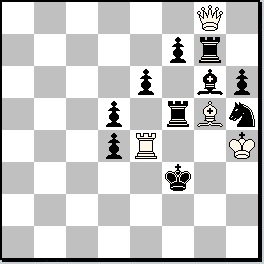
Composer Cooperations (6)

It is very probable that there exist more compositions with recent cooperations, and if any Greek composers want to inform me, I will update this post. I select two of the cooperating teams for today.

Problem-823
Fadil Abdurahmanovic (Bosnia-Herzegovina) and Ioannis Kalkabouras (GRE)
KobulChess.com 17.11.2015, no.269
8/8/2b5/8/8/2Ppk2p/pp5P/3sK2R (4 + 7)
h#4, 2 solutions


1.Sf2 0-0 (Rf1??) 2.Kd2 Kxf2 3.Kc2 Ke1 4.Kb1 Kd2#

1.Kf3 Rf1+ (0-0??) 2.Kg2 Rf3 3.Kxh2 Kf1 4.Kh1 Rxh3#

In one variation the castling is a good move, in the other it is not effective. The "wrong" moves are noted with double question mark.


Problem-824
Emmanuel Manolas (GRE) and Ioannis Kalkavouras (GRE)
3rd Hon. Mention, Moskovski Concurs 2016 
8/3p4/k2r2PK/1r6/3ss3/p4bb1/2S1p3/6q1 (3 + 11)
h=10, Helpstalemate
Fairy condition : Circe


1.Ka7 Sxa3 2.Ka8 Sxb5 3.Kb8 Sxd4 4.Kc8 Sxf3 5.Kd8 Sxg1 6.Ke7 Sxe2 7.Kf8 Sxg3 8.Kg8 Sxe4 9.Kh8 Sxd6 10.Kg8 g7=

It is a help-stalemate. Initially the Black helps a lot for his pieces to be captured, and at the end the White helps a lot tryin to avoid winning! 

The comment of the judge : "Circe, with nine pieces captured without rebirth! The essence of the problem : marching towards a stalemate trap, the bK passes from the rebirth squares of the black pieces, allowing the wS to capture all these pieces which would inhibit the stalemate, without any of them being reborn".

Sunday, May 08, 2016

Cooperations of composers (5)

We will see here the result of a cooperation of Ioannis Kalkavouras and Emmanuel Manolas, aiming to the composition of a helpmate in three and a half moves (that is, White plays first) with the following restrictions :
(a) The White has got only a Bishop and a Knight.
(b) The white pieces, B and S, will form with pericritical moves a battery which will fire with double check.
(c) The black in two variations makes different castling and is mated in the eighth row.
(d) No replacements of pieces (for twinning) is allowed.


Problem-815
Frank Fiedler
Gaudium, 2013
Source: WinChloe, no. 487666

r3k2r/8/8/4b3/8/4S1q1/8/1K1B4 (3 + 5)
h#3, 2 solutions


1.0-0 Sd5 2.Bh8 Bb3 3.Qg7 Sf6#
1.0-0-0 Sf5 2.Bb8 Bg4 3.Qc7 Sd6#

Here is shown the idea in simple form. The wB could be positioned on e2. 
The wK, to avoid checks by bR and bQ, could be only on columns b and e. But, with wKb5 the solutions are 1507, with wKe6 the solutions are 1283 and with wKe4 the solutions are 32. The wK is very well placed on b1! 
The white movements are not pericritical, they simply form the battery.
If we force the restriction h#3,5, then many unwanted solutions appear, 68 in total.


Problem-816
Anatoly Styopochkin
JT Feoktistov-50, Shakhmatnaya Kompozitsiya 1998-2000, 1st Honourable Mention
Source: WinChloe, no. 161976

r3k2r/s7/1p2B3/p2S2q1/4p3/3b4/8/b2K4 (3 + 10)
h#3.5, 2 solutions


1…Bg8 2.0-0-0 Bh7 3.Kb7 Bxe4 4.Ka6 Sc7#
1…Bc8 2.0-0 Ba6 3.Bh8 Bc4 4.Qg7 Sf6#

The nice movements of the wB are pericritical and the bishop forms the battery in both variations. But the two mates do not happen on the eighth row


Problem-817
Ioannis Kalkavouras and Emmanuel Manolas
original

r3k2r/8/8/3Sbp2/4b1B1/4Ksq1/8/8 (3 + 8)
h#3.5, 2 solutions


1…Bh3 2.0-0 Bf1 3.Bh8 Bc4 4.Qg7 Sf6#
1…Ke2 2.0-0-0 Se3 3.Bb8 Sxf5 4.Qc7 Sd6#

In one variation the white battery is formed by the wB moving clockwise, and in the other by the wS moving anti-clockwise.
The two mates appear symmetrical in the eighth row (vertical mirror, echo mates(0,4)). 

Thursday, December 31, 2015

Awarded chess problems by Greek composers, 2015

Awarded Compositions GR, 2015

(Last Update : 03/01/2016)

In this post we have gathered the artistic chess compositions of the Greek composers, which have earned a distinction in composing tourneys of the year 2015.
There were more publications, but here we are limited only to awarded ones.
(A note by Alkinoos: If some award is omitted, which is possible since I do not read everything, the interested composer is kindly requested to send to me the necessary information to append it in this anniversary post. Thanks!).

In twelve (12) international composing tourneys there were seventeen (17) awarded compositions, atistic creations of five (5) Greek composers (sometimes with co-authors).

We stress here a fact, seldom happening in Greece : This year we had organized here in our country one (1) international composing tourney : JT Manolas-65.

The entries to the composing tourneys are judged by a Judge and they get distinctions (by descending order): Prize or Place, Honourable Mention, Commendation.
In some interesting cases the distinction might be preceded by the word 'Special'.
The distinctions may be numbered or not.

Argirakopoulos Themis


Problem-2015-10
Argyrakopoulos Themis
4th Place, Marianka 2015
Source: http://www.jurajlorinc.com/chess/ma15faaw.htm
2B5/3Pp3/2p4p/3R4/7k/2K4p/6p1/8  (4 + 6)
hs+2,5
twins: a) diagram, b) wKc3 to d4, c) wKc3 to e1, d) wKc3 to h2
Messigny

a) wKc3
1…g1=Q 2.d8=Q Qd8Qg1 3.Qe1+ Qe1Qd8+

b) wKd4
1…g1=R 2.d8=R Rd8Rg1 3.Rg4+ Rg4Rd8+

c) wKe1
1…g1=B 2.d8=B Bd8Bg1 3.Bf2+ Bf2Bd8+

d) wKh2
1…g1=S 2.d8=S Sd8Sg1 3.Sf3+ Sf3Sd8+

Messigny = A piece (King included) can also swap places with an opposite piece of the same nature. Neither of the two pieces must have swap its place the previous move.

Theme Babson, (AUW, promotions of the same type by White and Black).

Problem-2015-13
Argirakopoulos Themis
2nd Honourable Mention, 13° Tzuika, Ostroda, 2015
Source: http://www.wccc2015.com/docs/congress_bulletin.pdf
 5(SL)Bk/2pp2pP/5p(EL)1/5p2/1p(LE)p2P1/PP6/K2P4/2q5 (8 + 11)
hs#3
twins: a) diagram, b) bPb4 to a4
Sentinelles : (g6 Elan EL), (c4 Leo LE), (f8 Super-Leo SL)

a) bPb4
1.LEe2(+c4) SLd6 2.LEg2(+e2) SLh2(+d6) 3.LEh3(+g2)+ ELxh3(+g6)#

b) bPa4
1.LEd5(+c4) SLe8 2.LEf7(+d5) SLe6 3.LEf8(+f7)+ ELxf8(+g6)#

Sentinelles : When a piece (Pawn excluded) leaves a square outside the first and last rows, it leaves a Pawn of the color of the side that played unless 8 Pawns in this color are already on the board.

The triple pin mate is achieved with the help of a fairy unit, the SuperLeo, which can capture over 2 hurdles. You certainly need an eagle eye and a sharp mind to anticipate the mate with three pinned units, of which two will be sentinels that will appear on the board during the solution. On the downside, the price paid by this ambitious achievement is the heavy position and the lack of interplay. Question: can anyone obtain a five-fold sentinel presentation of this splendid idea?

Argirakopoulos Themis, Prentos Kostas


Problem-2015-02
Argirakopoulos Themis, Prentos Kostas
1st Prize (1st - 3rd place)- TT 157 Superproblem
Source: https://yadi.sk/i/Iho1AFq4mNeij
6K1/6b1/1sp1rp2/1b1k4/p1p1q3/2r1pp2/1p1P3p/Q1s5  (3 + 16)
h#2, 1 solution per twin
twins: a) diagram, b) wQa1 to a8, c) wQa1 to h8, d) wQa1 to h1

a) wQa1
1.Kc5 dxc3 2.Qd5 Qa3#

b) wQa8
1.Kd6 d4 2.Sd5 Qd8#

c) wQh8
1.Ke5 dxe3 2.Kf5 Qh5#

d) wQh1
1.Kd4 d3 2.Kxd3 Qd1#

Model mates. WP4 from wPd2, with bK cross and the wQ visiting the four corners.                                          

Abdurahmanovic Fadil, Kalkavouras Ioannis


Πρόβλημα-2015-17
Abdurahmanovic Fadil, Kalkavouras Ioannis
1st Prize, Moskow Concours 2015
Source: http://www.selivanov.ru/download/Awards/Moscow/2015/%20mt2015-h.pdf
4s3/4s3/8/8/4k2p/1p1p2PP/bp1K1p2/qB6  (4 + 10)
h#5, 2 solutions

1.Sf5 Bc2 2.b1=Q Bd1 3.Qe5 Be2 4.Qba1 Bf1 5.Qad4 Bg2#

1.Kf3 Kc3 2.Ke2 Bxd3+ 3.Kd1 Be4 4.Kc1 Kd3 5.Kb1 Kd2#

Wb and Bk Platzweschel, wK triangular Rundlauf and wB zig zag from b1 to g2.       

Problem-2015-03
Abdurahmanovic Fadil, Kalkavouras Ioannis
3rd Prize, ЮК «С.Билык-50» Bilyk-50
Source: http://sachmatija.puslapiai.lt/sites/default/files/Bilyk2015.pdf
RS6/Br6/8/6K1/8/8/P7/3k4  (5 + 2)
h#2, 2 solutions

1.Rxa7 Sc6 2.Rxa2 Sd4 3.Rd2 Ra1#
1.Rxb8 Be3 2.Rb2 Rc8 3.Re2 Rc1#

Bicolour Bristol, Annihilation of white pieces, Self-blockings, Model mates.

Judge (Bilyk) :Аннигиляция белых фигур, правильные маты на краю доски, чередование функций белых коня и слона. Белая пешка вводит диссонанс: в одном решении она уничтожается чёрной ладьёй – двойная аннигиляция на вертикали ”a”, а во втором матовом финале участия не принимает, выполняя роль технической фигуры. 

Manolas Emmanuel


Problem-2015-07
Manolas Emmanuel
6th Honourable Mention, Gennady Kozura-60 JT
Source: http://www.chess-kopyl.com.ua/images/2015/12_2015/1_Козюра-60_2_оконч.pdf
R7/8/8/1kB5/8/8/1p4P1/1K1B4  (5 + 2)
h#2, 2 solutions per twin
twins: a) diagram, b) bKb5 to h1

(after Youness Benjelloun, 8/8/2pP4/2Bk4/5PR1/8/2p5/2KB4, (6+3), h#2, 2sols,
Problem Paradise vol18 January-March 2015, problem H706)
a) bKb5
1.Kc4 Be2+ 2.Kb3 Ra3#
1.Kc6 Rc8+ 2.Kd7 Bg4#

b) bKh1
1.Kh2 Bf3 2.Kh1 Rh8#
1.Kxg2 Rg8+ 2.Kf1 Rg1#

Section h#2 HotF (Helpmate of the Future)                                                                                            

Problem-2015-08
Manolas Emmanuel
Special Honourable Mention, Gennady Kozura-60 JT
Source: http://www.chess-kopyl.com.ua/images/2015/12_2015/1_Козюра-60_2_оконч.pdf
3S4/8/3p2p1/2pkr2b/3P4/3K4/Pr4P1/8  (5 + 7)
h#2, 4 solutions

1.Bf3 gxf3 2.Re4 fxe4#
1.Rb3+ axb3 2.c4+ bxc4#

1.Bg4 Sc6 2.Be6 Se7#
1.Rb6 Se6 2.Rc6 Sf4#

Section h#2 HotF (Helpmate of the Future)                                                                                           

Pergialis Nikos


Problem-2015-01
Pergialis Nikos
Commendation, Manolas-65 JT
Source: http://chess-problems-gr.blogspot.gr/2015/08/award-for-manolas-65-jt.html
8/8/4P3/8/2qkp3/8/8/2Q1S2K  (4 + 3)
h#2, 2 solutions per twin
twins: a) diagram, b) wQc2 to g8

a) wQc1
1.Qd3 Qc6 2.e3 Sf3#
1.Qxe6 Sd3 2.Kd5 Qc5#

b) wQg8
1.Ke3 Sc2+ 2.Kf2 Qg2#
1.Ke5 Sf3+ 2.Kf6 Qf7#

Section Α, HotF (Helpmate of the Future).
Judge (Kalkavouras Ioannisς) : "Preventive selfblocks and nice model mates; what else one might expect from a little precious stone?"

Problem-2015-04
Pergialis Nikos
Special Honourable Mention, Gennady Kozura-60 JT
Source: http://www.chess-kopyl.com.ua/images/2015/12_2015/1_Козюра-60_2_оконч.pdf
8/4q3/1ps2B2/3PP1q1/p1BkP3/1r/3Ss3/5K2  (7 + 8)
h#2, 4 solutions

1.Qgxe5 Bh4 2.Sc3 Bf2#
1.Qexe5 Bd8 2.Rc3 Bxb6#

1.Ke3 Bxe7 2.Sed4 Bxg5#
1.Kc5 Bxg5 2.Scd4 Bxe7#

Section h#2 HotF (Helpmate of the Future).
Judge (Valery Kopyl ) : Чёткий HOTF, замечательная игра полей, но… практически полная симметрия

Problem-2015-05
Pergialis Nikos
11th Honourable Mention, Gennady Kozura-60 JT
Source: http://www.chess-kopyl.com.ua/images/2015/12_2015/1_Козюра-60_2_оконч.pdf
8/5P2/K2p2p1/3rS1p1/3k4/2p5/b7/R7  (4 + 7)
h#2, 4 solutions

1.Bb1 Ra4+ 2.Kc5 Rc4#
1.Kc5 Rb1 2.Rd4 Rb5#

1.Ke3 f8=Q 2.Kd2 Qf2#
1.Kxe5 Re1+ 2.Kf6 f8=Q#

Section h#2 HotF (Helpmate of the Future)                                                                                           

Problem-2015-06
Pergialis Nikos
Special Honourable Mention, Gennady Kozura-60 JT
Source: http://www.chess-kopyl.com.ua/images/2015/12_2015/1_Козюра-60_2_оконч.pdf
R2K4/5k2/8/8/5B2/4S3/8/8  (4 + 1)
h#2, 2 solutions per twin
twins: a) diagram, b) bKf7 to d2

a) bKf7
1.Kf6 Ke8 2.Ke6 Ra6#
1.Kg6 Ra6+ 2.Kh5 Rh6#

b) bKd2
1.Kc1 Be5 2.Kb1 Ra1#
1.Ke2 Ra2+ 2.Ke1 Bg3#

Section h#2 HotF (Helpmate of the Future)                                                                                            

Prentos Kostas


Problem-2015-09
Prentos Kostas
1st Place, 36° R.I.F.A.C.E. (St-Germain au Mont d'Or, 22-25 mai 2015)
Source: http://phenix-echecs.fr/Messigny/RIFACE_2015_jugement_retros.pdf
1s1qkbsr/P1P1P3/2rPbPPP/8/6pp/1Qpp1pp1/1p2pB1P/RS2KBSR  (16 + 16)
Proof game in 17,5 moves
Anti-(Take and Make)

1.a4 b5 2.axb5(b4) a5 3.bxa6 e.p.(a4) Rxa6(a7) 4.c4 bxc3 e.p.(c5) 5.b4 axb3 e.p.(b5) 6.Qxb3(b2) d5 7.cxd6 e.p.(d4) c5 8.bxc6 e.p.(c4) Rxc6(c7) 9.e4 dxe3 e.p.(e5) 10.d4 cxd3 e.p.(d5) 11.Bxe3(e2) f5 12.exf6 e.p.(f4) e5 13.dxe6 e.p.(e4) Bxe6(e7) 14.g4 fxg3 e.p.(g5) 15.f4 exf3 e.p.(f5) 16.Bf2 h5 17.gxh6 e.p.(h4) g5 18.fxg6 e.p.(g4)

Proof game : Find the unique moves, from the initial position of the pieces when starting a game, to the position of the given diagram. 

Anti Take & Make : When a piece is "captured" (King excluded), it must move without capturing from its vanishing square. The capture is impossible if the captured piece can't be reborn.

13 en-passant captures.                                           

Problem-2015-11
Prentos Kostas
7th Honourable Mention, 18° Sabra, Ostroda, 2015
Source: http://www.wccc2015.com/docs/congress_bulletin.pdf
6Q1/5pr1/4p1bp/3p1rBs/3pR2K/5k2/8/8  (4 + 10)
h#2
twins: a) diagram, b) wQg8 to h7

a) wQg8
1.Bh7 Be3 2.Rg4+ Qxg4#

b) wQh7
1.Rf6 Re2 2.Bd3 Qxd3#

Bicolour Bristol, Orthogonal-Diagonal Transformation, Black line opening by White and by Black.                            

Problem-2015-12
Prentos Kostas
2nd Prize, 13° Tzuika, Ostroda, 2015
Source: http://www.wccc2015.com/docs/congress_bulletin.pdf
b3rrQ1/3p4/8/7B/s2K4/p7/S1k5/8  (4 + 7)
hs#3,5
twins: a) diagram, b) -wSa2

a) with wSa2
1…Bh1 2.Qg2+ Kb3 3.Kd5 Rf1 4.Bd1+ Rxd1#

b) without wSa2
1…Re1 2.Be2 Sb2 3.Ke3 Kc3 4.Qc4+ Sxc4#   

The most economic achievement of the tourney. In this problem too all three different white and black pieces reach the pin line during the solutions. The epitome of elegance and refinement, in an unbelievable Meredith setting and long moves played by both sides. The slight mismatch in the motivation of black moves doesn’t detract at all the artistic impression.

Problem-2015-14
Prentos Kostas
3rd Recommendation, 3° Azemmour, Ostroda, 2015
Source: http://www.wccc2015.com/docs/congress_bulletin.pdf
q7/4s3/1p2B1bS/4k1pp/2KR2p1/4pPr1/5s2/b7  (5 + 12)
h#2,5, two solutions

1…Rxg4 (A) 2.Sc6 f4+ 3.Ke4 Bd5# (B)

1…Bg8 (B) 2.Bf5 Sf7+ 3.Ke6 Rd6# (A) 

The White is closing white lines. Critical squares f4 and f7. Pieces wB and wR are exchange their roles in the two solutions.

Problem-2015-15
Prentos Kostas
2nd Honourable Mention, 15° Sake, Ostroda, 2015
Source: http://www.wccc2015.com/docs/congress_bulletin.pdf
White : Kh1, Black : Kh3, Neutral : Qb4 Re4 Bf8  (1 + 1 + 3)
h#2
twins: a) diagram, b) nQb4 to f4
Face to Face

a) nQb4
1.nRe6 nQb3+ 2.nBb4 nBe7#

b) nQf4
1.nBa3 nQf5+ 2.nRg4 nRa4#

Face-to-Face: When a white piece is just one rank below a black piece on the same file, they exchange their walk.

Miniature. Reciprocal Anti-batteries. Orthogonal-Diagonal Transformation.

There are several entries that tried to show ODT in a few pieces, but we think this one is the best and the most elegant in spite of the slight discrepancies between two solutions (FTF-specific battery in a) and ordinary battery in b)). 

Problem-2015-16
Prentos Kostas
4th Prize, 4° FIDE Cup in Composing, 2015
Source: http://www.wfcc.ch/wp-content/uploads/E-4FIDECUP-fin.pdf
6b1/6sp/prP1B1p1/r1R5/pS2kPP1/2P1P3/1K6/5s2  (9 + 10)
h#2.5
2 solutions

1…Bb3 2.Bc4 Bd1 3.Bb5 Re5#

1…Rh5 2.Rf5 Rh3 3.Rf7 Bd5#

Reciprocal interception of the pair Ra5/Bg8 on two different squares. That is the novelty for this matrix. See pdb/P0579541 and yacpdb/383043.
“Bicolor Bristol line opening and ODT. Although the white piece that opens the line will move again on the second move, the motivation for the Bristol is quite clear, as becomes evident by the "tries": {1...Bc4? (2…Be2) 3.??} and {1...Rd5? (2…Rd3) 3.??}” (author).

Friday, July 05, 2013

Composers' cooperations (3)

In this post we will see five problems created by cooperative composers. In general, the chess composition is a lonely activity. Most of the time it is you and your chessboard, or even your computer running the proper software. But often the composers share an idea with someone else and the composition has more than one parents.
Who has done most of the work? Finally, it does not matter. The cooperation is worthwhile.
Whose name will be written at the top? We said, it does not matter. The main thing here is that the composers cooperate and sometimes they become friends.
There are in the chess history rare cases, where composers having together awarded compositions, at the end they do not speak to each other.


Problem-710
Ioannis Kalkavouras, Greece
Emmanuel Manolas, Greece
2nd Com., www.problemiste.com, Problem 6, 1/2012

2R1RB2/bs1p1p2/5k1K/2pp1Pps/rPPp2P1/3p4/1r3P2/8 (9 + 13)

#10

Try : {1.Re1?  [2.Be7#]  Re2!}

Key : 1.f4! [2.Be7# / fxg5#]
1…gxf4 2.Be7+  Ke5 3.Bd8+ Kd6 4.Bc7+ Kc6 5.b5+ Rxb5 (the bRb2 goes away)
6.Bd8+ Kd6 7.Be7+ Ke5 8.Bf8+ Kf6 9.Re1 ~ 10.Be7#
The travel of the black king is named pendulum. The problem is characterized Logical, that is what can not be done with the try, it appears again during the main solution of the problem.

Problem-711
Ioannis Kalkavouras, Greece
Emmanuel Manolas, Greece
MATPLUS 39-40, Autumn-Winter 2010, Problem 1675

5R2/5K2/2p2B2/2p2kpS/2p5/SPpb1P2/Pbs2p2/s2B1r2 (9 + 12)

#8

Try : {1.Re8? [2.Re5#] Re1!}

Key : 1.Sb5! [2.Sd6#]
1…cxb5 2.Rc8 [3.Rxc5#] Ba3 3.b4 [4.Rxc5#] Bxb4 4.Re8 [5.Re5#] Re1 5.Be2 [6.Re5#] Rxe2 6.Rg8 [7.Rxg5#] Re7+ 7.Kxe7 ~ 8.Rxg5#

The problem is characterized Logical, that is what can not be done with the try, it appears again during the main solution of the problem.

Problem-712
János Mikitovics, Hungary
Emmanuel Manolas, Greece
juliasfairies.com 290

White : Kd3, Black : Kd6 Qh8 Re6 Bh3 Pd5h5g3, Neutral : Pe2, (1 + 7 + 1)
The neutral pawn takes the color of the side which has the move.
series auto-stalemate in 14 (White plays 14 moves and becomes stalemated).

a) Diagram : condition Circe PWC (exchange of places during capture)
b) +bRg5 : condition  KoBul Kings

a) 1.Kc2 2.e4 3.exd5(+bPe4) 4.dxe6(+bRd5) 5.e7 6.e8=nR (it is promoted to neutral Rook)
7.nRb8 8.nRxh8(+bQb8) 9.nRxh5(+bPh8) 10.nRh7 11.nRxh3(+bBh7) 12.nRh1 13.nRe1 14.nRxe4(+bQe1) auto=

b) 1.Rd2 2.e4 3.Ke3 4.Kf4 5.exd5 6.dxe6(bK=bRK) 7.e7 8.e8=nB (it is promoted to neutral Bishop) 9.nBxh5(bRK=bK) 10.nBg4 11.Kxg3 12.Kh2 13.Kh1 14.nBxh3(bK=bBK) auto=

Problem-713
Vito Rallo, Italy
Emmanuel Manolas, Greece
variantim April 2013, problem 2363

8/8/8/8/8/1K2SP2/4k3/4s3 (3 + 2)

h#3, 2 solutions, condition Andernach (= the capturer changes color)

1.Sxf3(=wSf3) Sd4+ 2.Kd2 Ka2 3.Kc1 Sb3#

1.Kd2 Sd5 2.Kd1 Kb2 3.Sxf3(=wSf3) Sc3#

Ideal mates, Chameleon Mates (0,1), reversal of two black moves.

Problem-714
Vito Rallo, Italy
Emmanuel Manolas, Greece
juliasfairies.com 247

8/8/8/8/K7/pGG5/k7/s7 (3 + 3) (Grasshoppers b3 c3 + 0)

h#3.5, Helpmate in 3.5 κινήσεις (that is white plays first)
2 solutions, Andernach (= the capturer changes color)

1…Gd3 2.Sc2 Ge3 3.Ka1 Kb3 4.Sxe3(=wSe3) Sc2#

1…Kb4 2.Sxb3(=wSb3) Sd2 3.Ka1 Kb3 4.a2 Ga3#

In the same page of juliasfairies.com, there is the problem 248, another composition from the ones we create together with the Sicilian Vito Rallo.
  

Friday, May 17, 2013

The Problemist (and some Greek composers)

The chess magazine The Problemist is issued by the British Chess Problem Society (BCPS, www.theproblemist.org/) since many decades and it has earned world wide recognition.
I have recently received the issue [The Problemist, Volume 24, No 1, January 2013] which has 48 pages and a supplement [The Problemist Supplement, Issue 122, January 2013] with 12 pages. The variety of the subjects is huge and it covers every genre of the chess composition.

Here we present Greek composers' problems, which are mentioned or published in this issue.

Problem-694
Ioannis Kalkavouras
C11037 The Problemist July 2012

7S/1KB1p2p/1PB2p1r/1p3P2/2k1S1p1/b1P3pq/bPP2P1R/5s2 (12 + 12)
#10, moremover in ten
1.b3+? Bxb3!
1.Bd7! [2.Be6#] Kd5 2.f3 gxf3 3.Bc6+ Kc4 4.Rd2 [5.Rd4#] Sxd2 5.Sxd2+ Kc5 6.Bd8 [9.Bxe7#] Kd6 7.Sf7+ Bxf7 8.Bc7+ Kc5 9.Se4+ Kc4 10.b3#

Logical problem, (what is impossible in the try-play, becomes possible after the key).

Problem-695
Petros Lambrinakos
Commendation, The Problemist 2011

s7/3S4/5p2/3k4/8/4R3/1Q6/7K (4 + 3)
#3, τριάρι
1.Qb8!
1…Sb6 2.Qxb6 [3.Qc5#]
1…Sc7 2.Qxc7 [3.Qc5#]
1…Kc4 2.Qb3+ Kd4 3.Qd3#
1…Kd4 2.Qb3 [3.Qd3#]
1…Kc6 2.Rd3 [3.Rd6#] Sb6/Sc7 3.Qxb6#/Qb6#
1…f5 2.Rd3+ Kc4/Ke4/Kc6/Ke6 3.Qb3#/Sc5#/Rd6#/Qe8#

Logical problem. Give-and-take key with X-flights for the bK.

Problem-696
Petros Lambrinakos
Commendation, The Problemist 2011

3K4/8/2S1p3/3kSP2/2p2p1P/8/8/1Q6 (6 + 4)
#3, three-mover
1.Qf1! [2.Qxc4+ Kd6 3.Sf7#/Qd4#]
1…Ke4 2.Ke7 Ke3/Ke5/Kxf5/c3/f3/exf5 3.Qe1#/Qxc4#/Qb1#/Qd3#/Qxf3#/Qf3#
1…Kc5 2.Kc7 [3.Qxc4#]

ODT, Flight-giving key.

Problem-697
Petros Lambrinakos
PS2671 The Problemist Supplement January 2013

2B5/3K4/5p2/8/7p/7k/3Q2S1/8 (4 + 3)
#3, three-mover
1.Qf2? [2.Se3 [3.Qg2#]] Kg4!
1.Se3? [2.Qg2#] Kg3!

1.Bb7! [2.Qf4 [3.Qxh4#]]
1…Kh2 2.Qf2 [3.Sf4#] Kh3 3.Qxh4#
1…Kg4 2.Qh6 Kg3/Kh3/Kf5/h3/f5 3.Qxh4#/Qxh4#/Qh5#/Qg6#/Qxh4#
1…f5 2.Qf2 [3.Qxh4#] Kh2 3.Sf4#

ODT, Model mates.

Problem-698
Petros Lambrinakos
PS2595 The Problemist Supplement July 2012

8/8/1Q6/1p1pKB2/1P6/5k2/5pr1/5R2 (5 + 5)
#3, three-mover
1.Qxf2+?/Qe3+?/Qd4?/Qc5? Rxf2!/Kxe3!/Rh2!/d4!

 1.Qa7! [2.Qa3+ Ke2 3.Qd3#]
1…Rh2 2.Qd4 Rg2/Rh~/Ke2/Kg2/Kg3 3.Qd3#/Qxf2#/Qd3#/Qxf2#/Qg4#
1…Ke2 2.Qd4 [3.Qd3‡] Rg3/Kxf1 3.Qxf2#/Qd1#
1…Kg3 2.Qd4 [3.Qf4‡] Rg1/Rh2/Kh2/Kf3 3.Qxf2#/Qg4#/Qh4#/Qd3#

Logical problem.

Problem-699
Vyron Zappas
3rd Prize, Problemistas 1970

3r4/1p1r1p2/3s1p2/1qpKPPp1/2R3p1/1S1kbs1R/b2P2Q1/3B1S2 (10 + 14)
s#2, self-mate two-mover
1.Sxc5+? Bxc5!
1.Rd4+? Bxd4!

1.Qxg4! [2.Qe4+ Sxe4#]
1…Sxd2 2.Sxc5+ Qxc5#
1…Bf4 2.Rd4+ cxd4#
1…Qxc4+ 2.Qxc4+ Sxc4#

Theme Rudenko, (two try-moves are reappearing in the after-key variations).

Problem-700
Emmanuel Manolas
The Problemist January 2013

6Rb/4s3/6P1/PS6/1pBp4/8/8/k1K4b (6 + 6)
#6, KoBul kings, more-mover in six
1.Sxd4? [2.Sc2#] Bxd4(wK=wSK)!

1.g7! [2.gxh8=(Q/B)(bK=bBK) [3.(Q/B)xd4(bBK=bK)#/Kb1#]
1…Bxg7 2.Rxg7(bK=bBK) [3.Kb1#] Bd5 3.Sxd4 [4.Sc2#] b3 4.Bxb3 [5.Sc2#]
4…Be4 5.Rxe7(bK=bSK) [6.Kb2#]
4…Bxb3(wK=wBK) 5.Rxe7(bK=bSK) [6.bKb2#]

Logical problem. Bicolour Bristol.

Problem-701
Ioannis Garoufalidis
PS2686F The Problemist Supplement January 2013

8/8/3k4/8/8/K7/1s6/R1S5 (3 + 2)
h#3, KoBul kings, Help-mate three-mover
1.Sa4 Kxa4(bK=bSK) 2.SKc4 Kb4+ 3.SKb2 Sd3#
1.Sd3 Sxd3(bK=bSK) 2.SKf7 Se5+ 3.SKh8 Rh1#
1.Ke5 Kxb2(bK=bSK) 2.SKf3 Ra3+ 3.SKg1 Rg3#

Problem-702
Ioannis Garoufalidis
PS2608F The Problemist Supplement January 2013

6b1/P5P1/8/3p1K2/8/2sP4/1p2r1p1/k7 (4 + 7)
ser-s#11, KoBul kings, Series-self-mate in 11
1.a8=B 2.Bxd5 3.Bxg8(bK=bBK) 4.Bc4 5.g8=R 6.Rxg2(bBK=bK) 7.Rxe2(bK=bRK) 8.Ke5 9.Kd4 10.Kxc3(bRK=bSK) 11.Rxb2(bSK=bK) Kxb2(wK=wRK)#

In Series-self-mate only the White plays. In the last move Black plays and mates.
Nice mate, difficult for the solvers.

Problem-703
Kostas Prentos
First Prize ex aequo, Bulgarian Wine Ty Kobe 2012

6Br/1pp4s/1R1B4/3S4/pp2k3/5p2/8/1r2bKs1 (5 + 11)
hs#3, Anti-Take and Make, Help-self-mate three-mover
b) -bSg1 (Twin without the black Knight of g1)
a) 1.Be5 cxb6(Rg6) 2.Bxh7(Sf6) Sg8 3.Rg2+ fxg2(Rg6)#
b) 1.Se3 Rxg8(Bc4) 2.Rxb4(b3) b5 3.Be2+ fxe2(Bc4)#

In (Take and Make) the capturing piece continues playing a move. In Anti-(Take and Make) the captured piece makes a move.
In the Help-self-mate the White plays first and cooperates with the Black to bring him to a mate position, but then the Black reacts by giving mate.

Reciprocal batteries.

Tuesday, October 07, 2008

Ioannis Kalkavouras (1)

“I was born in Kallithea (Attica Greece), in 1961, where I live.
I graduated, in Economics, from the Athens University and I work as an employee of Alpha Bank.
I started as a solver of chess problems, being influenced by the columns of Triantafyllos Siaperas in various newspapers of the eighties, and later I turned to composing, mainly as a means to express my creativity.
Now I have enough publications abroad, giving emphasis to Helpmates and Selfmates.”


Ioannis (John) Kalkavouras is a modest man with many prizes for his compositions. In the following, we will see three problems of his, having also his commentary.


(Problem 242)
Kalkavouras Ioannis,
Second Prize, Variantim (Israel), 2006
Helpmate in 2.5 moves. Two solutions.
h#2.5 21111 (4+12)
[1B6/8/3K1p2/1b6/3b3p/3r1qk1/Q2prp1s/3B2s1]

In helpmates having integer number of moves, the Black plays first. Here the moves are 2.5, thus we start with a move by White.

a) Key : 1...Qa2-d5! 2.Re2-e6+ Kd6xe6+ 3.Kg3-g4 Qd5-f5#
b) Key : 1...Qa2-e6! 2.Qf3-d5+ Kd6xd5+ 3.Kg3-f3 Qe6-e4#

I.K. comment : “Extended two-mover with exchange of places between wK and wQ on the squares d5/e6, interchange of sacrifices by half-pinned black pieces on the above squares and final pictures of mates with a pinned black piece.”


(Problem 243)
Kalkavouras Ioannis,
First Honourable Mention, Orbit (F.Y.R.O.M.), 2006
Helpmate in 3 moves. a) Diagramme, b) Twin -bPg2 +bPg3
h#3 (6+10) a) diagram b) bPg2 --> g3
[2R5/4p3/2b5/q5b1/2pP3r/1r3k1P/B1P2pp1/3K4]

a) Key : 1.Rb3-b4! (1.Bb5?) Ba2xc4 2.Bc6-e4 Bc4-d5 3.Rh4-f4 (Bf4?) Rc8-c3#
b) bPg2-->g3
Key : 1.Bc6-b5! (1.Rb4?) Rc8xc4 2.Rb3-e3 Rc4-c3 3.Bg5-f4 (Rf4?) Ba2-d5#

I.K. comment : “Line interferences of bQ with dual avoidance, elimination captures on c4, focal play, black Grimshaw with dual avoidance on f4”.

When there is a pair of answers but in every variation only one answer is valid we have dual avoidance.
We observe the similar strategy of the solutions : The Pawn c4 is captured by the wB, which continues his stride in order to pin a bB opening a line for the wR, which gives mate. The Pawn c4 is captured by the wR, which continues his stride in order to pin a bR opening a line for the wB, which gives mate.
Let us see the focal play : The bBc6, which stops Rc8-c3+ and guards Ba2-d5+, goes to e4 continuing to defend these, but unfortunately is pinned there allowing Rc8-c3+. The bRb3, which stops Ba2-d5+ and guards Rc8-c3+, goes to e3 continuing to defend these, but unfortunately is pinned there allowing Ba2-d5+.

Theme Focal play : A black linear piece (Queen, Rook, Bishop) focuses on two squares in two different directions, but when it moves it is forced to lose focus and abandon the guarding of one of the squares.

For the Grimshaw intersection, between linear pieces of unsimilar way of movement, we have already given many examples.


(Problem 244)
Kalkavouras Ioannis,
Die Schwalbe (Germany), 2005
Selfmate in 9 moves. There is set play. There are tries.
* s#9 (6+11)
[4R3/8/1p4B1/brR5/pp3p2/r2p1k1K/p1Pp4/6Q1]

Phase of the set play (*) : 1...b3? 2.Be4+ Ke2 3.Bxd3+ Kf3 4.Be4+ Ke2 5.Bg6+ Kf3 6.Rc3+ Bxc3 7.Bh5+ Rxh5#

Phases of tries : {1.Rc~? [2.Bh5+ Rxh5#] R(x)h5! 2.Bxh5# (of course it is completely wrong for a selfmate, the white to give mate, theme Berlin)},
{1.Be4+? Ke2! 2.Bxd3+ Kf3 3.Be4+ Ke2+}.

Phase of the actual game : Key : 1.Rd5! [2.Rxd3 Rxd3 3.Bh5+ Rxh5#] b3
2.Be4+ Ke2 3.Bxd3+ Kf3 4.Be4+ Ke2 5.Bg6+ Kf3
6.Qd1+ Kf2 7.Rxd2+ Bxd2 8.Re2+ Kf3 9.Bh5+ Rxh5#

I.K. comment : “Problem of Neo-German school (Logical) in combination with theme Berlin”.

The problems of the Neo-German school have a Preliminary plan (Vorplan), (which is needed for the General plan (Hauptplan) to be succesfully applied), which has appeared in the tries, but has failed. These problems are also called Logical problems. See the themes Roman, Hamburg and Dresden.
The move 2.Bxh5# of the try becomes 9.Bh5+ in the actual play. (Theme Berlin).

Theme Berlin : A move, which gives mate in a try, becomes a simple check in the actual play.


(This post in Greek language).