Showing posts with label __f#n. Show all posts

Sunday, April 05, 2020

Another composition in CoVID19 times

Today we present a problem by Ioannis Garoufalidis, awarded Greek solver and composer.

Condition: Because of the corona virus CoVID19 … the pieces must be kept in a distance from each other!
The condition is known as Anti-ContactChess or Anti-koko.

Problem-840


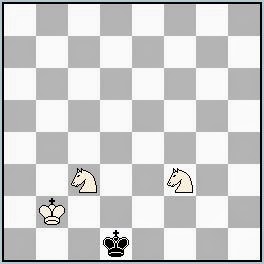
FEN: 8/3P2p1/8/8/8/k7/4p3/7K
h#2, (2+3)
twin: bKa3 to g5
Ioannis Garoufalidis (GRE)
original

Black plays and helps
White mate in two moves

Fairy condition:
Anti-koko


Condition Anti-koko: The moves, where one piece goes near another piece, are not legal and are prohibited. The capture of a piece is allowed.

a) bKa3
1.e1=S d8=Q 2.Sc2 Qa5#

b) bKg5
1.e1=B d8=R 2.Bg3 Rd5#

An Allumwandlung (AUW) problem with model mates.


Sunday, July 12, 2015

International Chess Composition Contest : "JT Manolas-65", C 12-VII-2015

Announcement 06-IV-2015, Last day for entries 12-VII-2015

International Chess Composition Contest : "Jubilee Tourney Manolas-65",
Closing date 2015-07-12.

The blogs
http://chess-problems-gr.blogspot.com (in English) and
announce the International Chess Composition Contest "JT Manolas-65".

Sections:
A. helpmate h#2, in HotF form (Helpmate of the Future), with at least two pairs of related solutions. Judge Ioannis Kalkavouras.
B. fairy #2, with accepted elements {one fairy condition} and/or {one fairy piece type}.  Judge Emmanuel Manolas.

Original computer-checked problems, (no zero-positions), may be submitted by each composer to one or both sections specifying :
Name & e-mail & country of the composer,
diagram & FEN notation & stipulation & solution of the problem.

Send documents by e-mail with subject "JT-Manolas-65" to manolas.emmanuel@gmail.com .
Closing day : 12-July-2015.

The participants will receive a copy of the award by e-mail.
The award will be published in the above blogs.

Διεθνής Διαγωνισμός Σκακιστικής Σύνθεσης : "Επετειακό Τουρνουά Μανωλάς-65",
λήξη 2015-07-12.

Τα ιστολόγια http://chess-problems-gr.blogspot.com (στα Αγγλικά) και
http://kallitexniko-skaki.blogspot.com (στα Ελληνικά)
ανακοινώνουν τον Διεθνή Διαγωνισμό Σκακιστικής Σύνθεσης "JT Manolas-65".

Τμήματα:
A. βοηθητικά h#2, σε μορφή HotF (Helpmate of the Future, Βοηθητικό του Μέλλοντος), με τουλάχιστον δύο ζεύγη συναφών λύσεων. Κριτής Ιωάννης Καλκαβούρας.
B. μυθικά #2, με αποδεκτά στοιχεία {μία μυθική συνθήκη} και/ή {ένα είδος μυθικού κομματιού}. Κριτής Εμμανουήλ Μανωλάς.

Αδημοσίευτα προβλήματα ελεγμένα από υπολογιστή (όχι zero-position) μπορεί να υποβάλει ένας συνθέτης σε ένα ή δύο τμήματα του διαγωνισμού, καθορίζοντας :
Όνομα και e-mail και χώρα του συνθέτη,
διάγραμμα και FEN συμβολισμός και εκφώνηση και λύση του προβλήματος.

Στείλτε έγγραφο μέσω e-mail με θέμα "JT-Manolas-65" στο manolas.emmanuel@gmail.com .
Ημερομηνία λήξης : 12-Ιουλίου-2015.

Οι συμμετέχοντες θα λάβουν ένα αντίγραφο της βράβευσης μέσω e-mail.
Η βράβευση θα δημοσιευθεί στα ανωτέρω ιστολόγια.


Thursday, October 03, 2013

Mate with two Knights on the edge of the chessboard

There is a beautiful problem by the French poet and novelist Alfred deMusset since 1849, which shows a mate with two Knights on the edge of the chessboard. In order to achieve such a mate, one must have another black piece on board, which may disappear in the final picture of mate, or a pawn not too advanced (see Troitsky line).

Problem-737
Alfred deMusset
La Regence, 1849
1s2k1K1/7R/8/4S3/6S1/8/8/8 (4 + 2)
#3, Mate in three moves

1.Rd7! [2.Sf6#] Sxd7
2.Sc6 Sf6+
3.Sxf6#
final picture of mate

I like this problem and I have composed, for a recent composition tourney, a helpmate two-mover twin.
On the first of the twins, White manages easily to force a mate on the cooperating Black with two Knights on the edge of the chessboard, (making two simple moves and two captures).
But on the second problem a black Rook is placed on board and inhibits the mate of the first twin! White, more difficult now (with four captures, pins, unpinnings and removals of guards), manages again to achieve the mate with two knights, but in another edge of the chessboard!
For a two-mover, I consider it nice, (and it is irrelevant that the judge saw the two solutions unsimilar and gave no distinction). Of course, the two fairy conditions were very helpful TakeAndMake (the capturing piece makes one move with the way of the captured piece. Example: if a Rook captures a Knight, the Rook must make one more step as Knight) and Anti-TakeAndMake (the captured piece is not removed from the game but it makes one move without capturing anything on the arrival square.
Final result, with the two fairy conditions combined, is a situation described recently as Bulgarian billiard.
Example: (1) if a Rook captures a Knight, the Rook must make one more step as Knight, and the Knight stays on the board and makes a move itself as a Knight. (2) if a Knight captures a Bishop, the Knight must make one move as Bishop, and the Bishop stays on the board and makes a move itself).

Problem-738
Manolas Emmanuel
original
8/1K6/8/6bS/8/5S2/5k2/1b6 (3 + 3)
h#2, helpmate in 2
conditions TakeAndMake, Anti-TakeAndMake

Twin a) Diagram,
b) +bRc6, addition of a black Rook

a)
1.Bg6 Sg3
2.Kxg3(Kh5;Se4) Sexg5(Sf6;Bh6)#

b) bRc6
1.Kxf3(Ke1;Sd2) Kxc6(Kc1;Rh6)
2.Rxh5(Rf4;Sg3) Sxb1(Sd3;Ba2)#
final picture of mate a
final picture of mate b

We have composed, together with the Italian Vito Rallo, problems with similar final mates, but using another fairy condition, Andernach (the capturing piece, changes colour).

Problem-713
Manolas Emmanuel and Rallo Vito
Variantim, April 2013
8/8/8/8/8/1K2SP2/4k3/4s3 (3 + 2)
#3
condition Andernach

1.Sxf3(=wSf3) Sd4+ 2.Kd2 Ka2 3.Kc1 Sb3#

1.Kd2 Sd5 2.Kd1 Kb2 3.Sxf3(=wSf3) Sc3#

Ideal Mates, Chameleon.
final picture of mate in first solution
final picture of mate in second solution

Problem-739
Manolas Emmanuel and Rallo Vito
Julia's Fairies Νο.248, February 07, 2013
8/2K1kss1/8/5PG1/8/8/8/8 (3 + 3)
(Grasshoppers: f5 + 0)
#3
condition Andernach
Grasshopper on g5

1.Kf8 Kd7 2.Sxf5(=wSf5) Sh6 3.Sxg5(=wSg5) Se6#

1.Ke8 Ge5 2.Sxe5(=wSe5) Sg6 3.Sxf5(=wSf5) Sd6#
final picture of mate in first solution
final picture of mate in second solution

Friday, May 17, 2013

The Problemist (and some Greek composers)

The chess magazine The Problemist is issued by the British Chess Problem Society (BCPS, www.theproblemist.org/) since many decades and it has earned world wide recognition.
I have recently received the issue [The Problemist, Volume 24, No 1, January 2013] which has 48 pages and a supplement [The Problemist Supplement, Issue 122, January 2013] with 12 pages. The variety of the subjects is huge and it covers every genre of the chess composition.

Here we present Greek composers' problems, which are mentioned or published in this issue.

Problem-694
Ioannis Kalkavouras
C11037 The Problemist July 2012

7S/1KB1p2p/1PB2p1r/1p3P2/2k1S1p1/b1P3pq/bPP2P1R/5s2 (12 + 12)
#10, moremover in ten
1.b3+? Bxb3!
1.Bd7! [2.Be6#] Kd5 2.f3 gxf3 3.Bc6+ Kc4 4.Rd2 [5.Rd4#] Sxd2 5.Sxd2+ Kc5 6.Bd8 [9.Bxe7#] Kd6 7.Sf7+ Bxf7 8.Bc7+ Kc5 9.Se4+ Kc4 10.b3#

Logical problem, (what is impossible in the try-play, becomes possible after the key).

Problem-695
Petros Lambrinakos
Commendation, The Problemist 2011

s7/3S4/5p2/3k4/8/4R3/1Q6/7K (4 + 3)
#3, τριάρι
1.Qb8!
1…Sb6 2.Qxb6 [3.Qc5#]
1…Sc7 2.Qxc7 [3.Qc5#]
1…Kc4 2.Qb3+ Kd4 3.Qd3#
1…Kd4 2.Qb3 [3.Qd3#]
1…Kc6 2.Rd3 [3.Rd6#] Sb6/Sc7 3.Qxb6#/Qb6#
1…f5 2.Rd3+ Kc4/Ke4/Kc6/Ke6 3.Qb3#/Sc5#/Rd6#/Qe8#

Logical problem. Give-and-take key with X-flights for the bK.

Problem-696
Petros Lambrinakos
Commendation, The Problemist 2011

3K4/8/2S1p3/3kSP2/2p2p1P/8/8/1Q6 (6 + 4)
#3, three-mover
1.Qf1! [2.Qxc4+ Kd6 3.Sf7#/Qd4#]
1…Ke4 2.Ke7 Ke3/Ke5/Kxf5/c3/f3/exf5 3.Qe1#/Qxc4#/Qb1#/Qd3#/Qxf3#/Qf3#
1…Kc5 2.Kc7 [3.Qxc4#]

ODT, Flight-giving key.

Problem-697
Petros Lambrinakos
PS2671 The Problemist Supplement January 2013

2B5/3K4/5p2/8/7p/7k/3Q2S1/8 (4 + 3)
#3, three-mover
1.Qf2? [2.Se3 [3.Qg2#]] Kg4!
1.Se3? [2.Qg2#] Kg3!

1.Bb7! [2.Qf4 [3.Qxh4#]]
1…Kh2 2.Qf2 [3.Sf4#] Kh3 3.Qxh4#
1…Kg4 2.Qh6 Kg3/Kh3/Kf5/h3/f5 3.Qxh4#/Qxh4#/Qh5#/Qg6#/Qxh4#
1…f5 2.Qf2 [3.Qxh4#] Kh2 3.Sf4#

ODT, Model mates.

Problem-698
Petros Lambrinakos
PS2595 The Problemist Supplement July 2012

8/8/1Q6/1p1pKB2/1P6/5k2/5pr1/5R2 (5 + 5)
#3, three-mover
1.Qxf2+?/Qe3+?/Qd4?/Qc5? Rxf2!/Kxe3!/Rh2!/d4!

 1.Qa7! [2.Qa3+ Ke2 3.Qd3#]
1…Rh2 2.Qd4 Rg2/Rh~/Ke2/Kg2/Kg3 3.Qd3#/Qxf2#/Qd3#/Qxf2#/Qg4#
1…Ke2 2.Qd4 [3.Qd3‡] Rg3/Kxf1 3.Qxf2#/Qd1#
1…Kg3 2.Qd4 [3.Qf4‡] Rg1/Rh2/Kh2/Kf3 3.Qxf2#/Qg4#/Qh4#/Qd3#

Logical problem.

Problem-699
Vyron Zappas
3rd Prize, Problemistas 1970

3r4/1p1r1p2/3s1p2/1qpKPPp1/2R3p1/1S1kbs1R/b2P2Q1/3B1S2 (10 + 14)
s#2, self-mate two-mover
1.Sxc5+? Bxc5!
1.Rd4+? Bxd4!

1.Qxg4! [2.Qe4+ Sxe4#]
1…Sxd2 2.Sxc5+ Qxc5#
1…Bf4 2.Rd4+ cxd4#
1…Qxc4+ 2.Qxc4+ Sxc4#

Theme Rudenko, (two try-moves are reappearing in the after-key variations).

Problem-700
Emmanuel Manolas
The Problemist January 2013

6Rb/4s3/6P1/PS6/1pBp4/8/8/k1K4b (6 + 6)
#6, KoBul kings, more-mover in six
1.Sxd4? [2.Sc2#] Bxd4(wK=wSK)!

1.g7! [2.gxh8=(Q/B)(bK=bBK) [3.(Q/B)xd4(bBK=bK)#/Kb1#]
1…Bxg7 2.Rxg7(bK=bBK) [3.Kb1#] Bd5 3.Sxd4 [4.Sc2#] b3 4.Bxb3 [5.Sc2#]
4…Be4 5.Rxe7(bK=bSK) [6.Kb2#]
4…Bxb3(wK=wBK) 5.Rxe7(bK=bSK) [6.bKb2#]

Logical problem. Bicolour Bristol.

Problem-701
Ioannis Garoufalidis
PS2686F The Problemist Supplement January 2013

8/8/3k4/8/8/K7/1s6/R1S5 (3 + 2)
h#3, KoBul kings, Help-mate three-mover
1.Sa4 Kxa4(bK=bSK) 2.SKc4 Kb4+ 3.SKb2 Sd3#
1.Sd3 Sxd3(bK=bSK) 2.SKf7 Se5+ 3.SKh8 Rh1#
1.Ke5 Kxb2(bK=bSK) 2.SKf3 Ra3+ 3.SKg1 Rg3#

Problem-702
Ioannis Garoufalidis
PS2608F The Problemist Supplement January 2013

6b1/P5P1/8/3p1K2/8/2sP4/1p2r1p1/k7 (4 + 7)
ser-s#11, KoBul kings, Series-self-mate in 11
1.a8=B 2.Bxd5 3.Bxg8(bK=bBK) 4.Bc4 5.g8=R 6.Rxg2(bBK=bK) 7.Rxe2(bK=bRK) 8.Ke5 9.Kd4 10.Kxc3(bRK=bSK) 11.Rxb2(bSK=bK) Kxb2(wK=wRK)#

In Series-self-mate only the White plays. In the last move Black plays and mates.
Nice mate, difficult for the solvers.

Problem-703
Kostas Prentos
First Prize ex aequo, Bulgarian Wine Ty Kobe 2012

6Br/1pp4s/1R1B4/3S4/pp2k3/5p2/8/1r2bKs1 (5 + 11)
hs#3, Anti-Take and Make, Help-self-mate three-mover
b) -bSg1 (Twin without the black Knight of g1)
a) 1.Be5 cxb6(Rg6) 2.Bxh7(Sf6) Sg8 3.Rg2+ fxg2(Rg6)#
b) 1.Se3 Rxg8(Bc4) 2.Rxb4(b3) b5 3.Be2+ fxe2(Bc4)#

In (Take and Make) the capturing piece continues playing a move. In Anti-(Take and Make) the captured piece makes a move.
In the Help-self-mate the White plays first and cooperates with the Black to bring him to a mate position, but then the Black reacts by giving mate.

Reciprocal batteries.

Tuesday, February 19, 2013

Award MT Alaikov-80

The Award for competition MT Alaikov-80 is published (second Section : fairies), which was held in memory of the Bulgarian composer Venelin Alaikov.
In this Tourney the Greek composer Themis Argyrakopoulos was awarded with 4th Prize and a Commendation.

Monday, January 14, 2013

Allumwandlung and Transmuted Kings

An interesting theme in chess composition is "All the Promotions" or "Allumwandlung" (AUW, from the German). We have presented many AUW problems. A pawn is promoted in the OTB chess, in four ways (to Queen, to Rook, to Knight, to Bishop). In fairy chess, where more pieces can be used, the promotions may be more than four, as we saw in the brilliant Problem-241.

The Kings have no great mobility in the OTB chess. For this reason, various conditions are invented to make them more active. We saw the condition of Transmuted Kings when presenting the Problem-269. We repeat the definition here :
When the Transmuted Kings are threatened by a piece, they move and capture in a way similar with the movement of the threatening piece. (If the wK is threatened by a bR leaves his square moving like a wR).

In today's post we will see a composition having both themes. It is an evolution of an idea of an old collaborator. It is a helpmate in two moves, with four solutions.

Problem-660
Manolas Emmanuel
original
1s3B2/2P2P2/2p1k1q1/8/8/8/5K2/8 (4 + 4)
h#2, 4111, Transmuted Kings

1.Ke5 cxb8=Q+ 2.Ka5 Bb4# (The bK must go away moving as Bishop, but is not able to reach a safe square).
1.Kd7 Bd6 2.Kc8 cxb8=R# (The bK must go away moving as Rook, but he can not).
1.Kf5 c8=S 2.Qxf7 Sd6# (The bK must go away moving as Knight, but he can not. Going, let us say, to d4, he discovers the bQf7, which is threating the wK, which then can move as Queen and capture the piece on d4. This was the aforementioned idea).
1.Qg5 Bg7 2.Ke7 f8=B# (The bK must go away moving as Bishop, but he can not).

The four promotions have been achieved, so this is an allumwandlung.

Monday, December 31, 2012

Last awards of 2012

On the last day of 2012, the award for the "Mark A. Ridley-50 Jubilee Tourney" is announced, and you can read it here : http://www.matplus.net/pub/ul/MarkRidley50JT.pdf

From the Greek side, three compositions won distinctions :

Themis Argyrakopoulos, Commendation

Themis Argyrakopoulos and Kostas Prentos, Commendation

Emmanuel Manolas, 1st Honourable Mention


In another award published today, mr Kostas Prentos (USA, as resident of Albuquerque) earned a commendation. Read this : http://juliasfairies.com/tourneys/tourneys-results/award-christmas-blitz-jf2012/

Sunday, December 23, 2012

Trees for the holidays

Traditionally, this time of each year the chess-composers send greeting cards to their friends with nice compositions. With the present advancement of the technology, the bloggers post these compositions in their blogs.
Some of these problems have special shape, like a Christmas tree.
On this post, together with cordial wishes for general improvement of the situations in our lives, I present three problems of mine with tree-like or conical shapes.
The third takes the shape of a tree, after you solve it!


Problem-646
Manolas Emmanuel
original
8/4q3/4k3/8/3sKP2/2p3p1/1p5P/8
(3 + 6)
a) Diagram: h#5,
b) bQe7 becomes bR: h#4

a) 1.b1=B+ Ke3 2.Bg6 hxg3 3.Kf5+ Kf2 4.Se6 Kf3 5.Qf6 g4#

b) 1.Rh7 f5+ 2.Kf7 f6 3.Kg8 f7+ 4.Kh8 f8=Q#

Self-blocks.


Problem-647
Manolas Emmanuel
original
8/3G4/2p1p3/3b4/2k1P3/1p3K2/3P4/8
(4 + 5) (Grasshopper d7 + 0)
h#4

1.e5 Κe2 2.Βf7 d3+ 3.Κd4 Κd2 4.c5 Gg7#

The Grasshopper is an obstacle-jumping piece. It moves in straight line on a row or a file or a diagonal, jumps over an obstacle and steps on the next square. (If the obstacle is missing, the move is not allowed. If behind the obstacle there is an opponent piece, it is captured).

Self-blocks. (The bPb3 is only decorative).


Problem-648
Manolas Emmanuel
original
diagram
8/3p4/8/3k3G/3p4/8/3P3G/GG1K1G2
(7 + 3) (Grasshopper a1 b1 f1 h2 h5 + 0)
h#3

1.d3 Gc5 2.Kd4 Ge5 3.d5 Gd6#

(It could be more economical, but the shape after solution would not be nice). Self-blocks. The final shape is shown to the right.


Friday, July 30, 2010

Local : Meeting of composers (7)

Alkinoos's note : I do not translate here all the posts from my original blog (kallitexniko-skaki in Greek language). Those posts containing local news only, not problems, are omitted. As an exception today, I give you the seventh meeting of the Greek problemists and a funny moment in the adventure of composition.

The seventh meeting of problemists was scheduled for Friday's evening 30/07/2010.
Mr Manolas Emmanuel was the host, welcoming in his home the company of Themis Argyrakopoulos, Ioaennis Garoufalidis, Panagis Sklavounos, Harry Fougiaxis.
We spoke about some of the problems which were submitted to the composition contest (JT Manolas-60) that ended July 12.
We examined the abilities of the special available software (WinChloe, Fancy+Popay) to represent and analyze these problems.

I relay to you a funny moment in this meeting. Using one of the programs, I put on a chessboard various fairy and normal pieces at random, creating the following position:
(Problem 469)
Manolas Emmanuel
original

h#4

The piece on c5 is an Imitator. After each move of a white or black normal piece, the Imitator makes its move similar in direction and distance. If the Imitator finds an obstacle in its move or goes out of the board, then the move of the normal piece is illegal.

One of the composers asked "What else is needed?" and I said "A Stipulation. I will put Helpmate in 4 moves".
You can imagine the surprise and laughter when program WinChloe examined it and found one solution only!!
Total time for composition : under half a minute!

1.Kf7[Imb6] Kh7[Imb5]
2.Kf8[Imb6] Kg6[Ima5]
3.Kg8[Imb5] Sc1[Imd4]
4.Kh8[Ime4] Kh7[Imf5]# (The white King boldly attacks. The black King can not capture the wK, because the Imitator trying to make the similar move is stopped by the Pawn).

After the conversations, we had a nice dinner in a friendly nearby delicacy-restaurant of Nea Smirni.

Tuesday, February 23, 2010

Doubleislander's dedication

Doubleislander's dedication

The problems on this post were sent as a present to the composition contest [Jubilee Tourney Emmanuel Manolas-60] by a friend who prefers to be anonymous. We will name him/her as Doubleislander (from two islands).
The problems are quite simple, but the pieces are set in a way to represent the symbols J T E M 6 0 (initials from the name of the tourney).
We thank the Thrilling Anonymous!


(Problem 429)
Doublislander,
dedicated to JT Manolas-60,
original,
Helpmate in 2. Condition : Circe.
h#2 Circe (4 + 8)
[8/3prssb/5k2/5r2/5b2/3P1K2/4QP2/8]


With condition Circe, the captured piece is reborn on its initial square (example : the wQ on d1).


(Problem 430)
Doublislander,
dedicated to JT Manolas-60,
original,
Helpmate in 2. Condition : Chameleon - Chess.
h#2 Chameleon Chess (3 + 7)
[8/1pppkp2/3b4/3p4/3P4/3S4/3K4/8]


Helpmate : Black plays and helps White to mate.
With condition Chameleon - Chess, the moving pieces are transformed (i.e. the Knight moves and becomes Bishop, the Bishop moves and then becomes Rook, the Rook moves and then becomes Queen, the Queen moves and then becomes Knight).


(Problem 431)
Doublislander,
dedicated to JT Manolas-60,
original,
Selfmate in 2 moves.
s#2 (5 + 8)
[KSrb4/s7/qpp5/k7/pRPS4/8/8/8]


Selfmate : White plays and forces Black to deliver mate.


(Problem 432)
Doublislander,
dedicated to JT Manolas-60,
original,
Helpmate in 2 moves.
h#2 (3 + 10)
[8/2R3K1/2bp1pp1/2r1k1q1/2p3s1/2P3p1/8/8]


(Problem 433)
Doublislander,
dedicated to JT Manolas-60,
original,
Helpmate in 2 moves. Condition : Madrasi.
h#2 Madrasi (5 + 8)
[8/1PB5/p2r4/b7/pPp5/k2R4/rsK5/8]


With condition Madrasi, if two dissimilarly coloured pieces of the same kind (i.e. wR and bR) are mutually threatened, then they are paralyzed and the only power they have, whilst the threat is pending, is to paralyze each other.


(Problem 434)
Doublislander,
dedicated to JT Manolas-60,
original,
Helpmate in two moves. Condition AntiCirce.
h#2 Anticirce (5 + 7)
[8/3pp3/2r2R2/2b2P2/2P2S2/2k2r2/3sK3/8]


With condition Anticirce, the capturing piece is reborn in its initial square. The captured piece disappears.


The solutions will be posted here in a few days.

Sunday, April 19, 2009

Easy win in four moves

The following diagram is a problem by Lord Dunsany (Edward John Moreton Drax Plunkett, 18th Baron Dunsany, 1878-1957), who was English man of literature and theatrical writer and good chess player with draws in games against Jose Raoul Capablanca.

A specimen of the poetic expression of Lord Dunsany :
"One art they say is of no use;
The mellow evenings spent at chess,
The thrill, the triumph, and the truce
To every care, are valueless.
"And yet, if all whose hopes were set
On harming man played chess instead,
We should have cities standing yet
Which now are dust upon the dead."


(Problem 349)
Lord Dunsany,
"Week-end Problems Book" by Hubert Phillips, 1932
Mate in 4 moves. Two solutions.
#4 retro ( 8 + 16 )
[RSBKQBSR/8/8/8/8/8/pppppppp/rsbqkbsr]

The diagram is accompanied by a story : Someone enters in a chess club and sees the pieces arranged this way on a chess board. They inform him "two eccentric gents were playing a game and when the White, who were ready to make a move, announced [Mate in 4 moves, with two ways!] the Black left angry and after him the White left also. Can you discover the continuation?"

While the hero of the story is thinking, can you dear readers find the two solutions of the problem?
If I do not receive comments with the solution, I will publish it soon at the end of this post.

Monday, March 30, 2009

Theme Stavrinides

The composer Alkis Stavrinides was born in Cyprus in 1947 and lives in the United Kingdom since 1967.
Byron Zappas writes in his book that he has cooperated with mr Stavrinides.
I have found in the Internet some problems by Stavrinides, which have presented the Theme Stavrinides around 1968.

Theme Stavrinides : The (compact algebraic) notation of white and black moves shows circular transposition.
Theme shown in one phase : 1. K!, 1...Aaa 2. Bbb#, 1...Bbb 2. Ccc#, 1...Ccc 2. Aaa#
Theme shown in tries : 1. Aaa? Bbb!, 1. Bbb? Ccc!, 1. Ccc? Aaa!


Let us see now some problems presenting the Theme Stavrinides.


(Problem 325)
A. Stavrinides,
British Chess Problemists Society (BCPS), 1968
Mate in 2.
#2 ( 8 + 7 )
[1SRB4/p2KP3/Q1S5/2kp4/2p5/2qP4/s2b4/8]


Tries : [1. Bb6+? / Qb6+ axb6!], [1. Sd4+? Kxd4!], [1. Qb5+? Kxb5!], [1. Qxa7+? Kb5!], [1. Qa5+? Qxa5!], [1. d4+? Qxd4!].

Key : 1. Qa4! ( > 2. Sa6#)
Watch now the cyclic transposition in the three variations :
1...Sb4 2. Qa5#
1...Qa5 2. d4#
1...d4 2. Sb4#


(Problem 326)
A. Stavrinides,
Probleemblad, 1969
Mate in 2.
#2 ( 6 + 5 )
[4Q3/8/3p2K1/5S2/4pkp1/8/4PqP1/B7]


A nice Meredith with cyclic transposition of the theme in four variations :

Tries : [1. Qxe4+? Kxe4!], [1. Qe5+? dxe5!], [1. Be5+? dxe5!], [1. Qe6? / Bg7? / Bf6? g3!], [1. Qe7? e3!], [1. g3+? / e3+? Qxe3!].

Key : 1. Qh8! ( > 2. Qh6#)
1...Qh4 2. e3#
1...e3 2. Qd4#
1...Qd4 2. g3#
1...g3 2. Qh4#


(Problem 327)
M. Stosic,
Arbeijder Skak, 1970,
Mate in 2.
#2 ( 13 + 9 )
[1S2K3/3R4/Bp2PP1P/1pkp2BR/b7/P2P4/1P1bS1s1/2q2r2]


Tries : [1. Rxd5+? Kxd5!], [1. Rc7+? Kd6!], [1. Bb7? b4!], [1. Bxd2? Qc4!], [1. Be3+? Sxe3!], [1. Bf4? Sxf4!], [1. d4+? Kc4!], [1. b4+? Bxb4!].

Key : 1. Ke7! ( > 2. Rc7#)
1...b4 2. d4
1...d4 2. Bf4
1...Bf4 2. b4


(Problem 328)
Jozef Taraba,
Europe Echecs, 1975,
Mate in 2.
#2 ( 9 + 6 )
[8/2Bp1R2/5S1K/Q1S1pkp1/1Rb5/2s3P1/1p2P3/8]


Tries : [1. Sd5+? / Sh5+? / Sh7+? / Sg8+? / Se8+? / Sxd7+? Kg4!], [1. Se6? Kxe6!], [1. Rxc4? Se4!], [1. e4+? Sxe4!], [1. g4+? Kf4!], [1. e3? Bxf7!].

Key : 1. Qa8! ( > 2. Qf3#)
1...Sxe2 2. Qe4#
1...Se4 2. Qxe4#
1...Bxe2 2. Sf6-d5,g4,h5,h7,g8,e8,d7#
1...Bd5 2. Sxd5# / 2. g4# (dual)
1...d5 2. Qc8#
and the three thematic variations...
1...Sd5 2. e4#
1...e4 2. g4#
1...g4 2. Sd5#

(Problem 329)
W. Piltschenko,
Themes 64, Jan-March 1981,
Mate in 2.
#2 ( 12 + 4 )
[8/1K6/6P1/1Sk2B2/P2RPr2/2S2P2/2b2sQ1/2R3B1]


Tries : [1. Rc4+? Kxc4!], [1. Rxc2? Rxf3!].

Key : 1. Qg5! ( > 2. Qe7#)
Here the three thematic variations show black and white captures on the same square.
1...Bxe4+ 2. Sxe4#
1...Sxe4 2. Rxe4#
1...Rxe4 2. Bxe4#


(Problem 330)
Vaclav Kotesovec,
First Honourable Mention, Probleemblad, 2002-3,
Mate in 2.
#2 ( 7 + 9 ) Grasshoppers ( 4 + 5 )
[gK6/8/3p2q1/3pg3/G2p3g/R2G4/Gg5R/k1G5]


Tries : [1. Ga2-c2+? Ga8xa3!], [1. Kb8xa8? Ka1-b1!].

Key : 1. Rh1! (zugzwang).
1...Ga8xa3 2. Gc1xa3#
1...Ga8-e4 2. Ga2-c2#
1...Ka1-b1 2. Gc1-a1#
And now we see the Theme Stavrinides with circular transposition in seven variations.
1...Gg6-c2 (Gc2) 2. Gc1-c3# (Gc3)
1...Ge5-c3 (Gc3) 2. Gc1-c4# (Gc4)
1...Gh4-c4 (Gc4) 2. Gc1-c5# (Gc5)
1...Ge5-c5 (Gc5) 2. Gc1-c6# (Gc6)
1...Gg6-c6 (Gc6) 2. Gc1-c7# (Gc7)
1...Ge5-c7 (Gc7) 2. Gc1-c8# (Gc8)
1...Ga8-c8 (Gc8) 2. Ga2-c2# (Gc2)

Friday, March 13, 2009

A three-mover as a problem for Arbiters

The problem of this post has a postulation [White plays and mates in 3 moves].
The composer Nikita Plaksin has produced more than 50 similar works of art with retroanalysis.
See here.
The solution is published in many places of the web, but please refrain from searching for it right away.

Suppose that you observe the position of a chess game.
Someone has whispered to you that White can mate in three moves.
By simple examination you see that there is an easy mate in two moves :
first the Queen checks and then the Rook gives the final blow (let say [1. Qf1+ Kxh2 2. Rh3#] ).

1) Why can not the Queen give check in the first move, and drive the White to an easy win?
2) What will the Black ask from the Arbiter after the check by the Queen in the first move?

3) Which are the correct three moves for the solution of this problem?

(Problem 322)
Nikita Plaksin,
1st and 2nd prize, Die Schwalbe, 1971
Dedicated to Dr K. Fabel
Mate in 3.
#3 retro ( 15 + 14 )
[1b1K3s/2pppprp/1p4p1/1p6/b1P2B2/RP2P1R1/r1PPQPPP/SB5k]


The solution follows. If you can solve the problem without seeing the solution, send a comment stating your solution.

(Sketch for Problem 322)
[rb5s/2pppp1p/1p4p1/1p5Q/bkP3K1/4P1R1/BPPP1PPP/SrB4R]


We start from a position (see the sketch exactly above and the source here) which can be reached from the initial placement of the pieces without special difficulty. The black Rook can go to b1, the black King can come out in the middle, the black Knight can leave from g8 allowing the other Rook to move to a8, then the black Bishop returns to b8 and the Pawn moves b7-b6, and the Knight goes to h8 and the Pawn moves g7-g6. Similarly with the white pieces, the white Rook goes from a1 to g3 and then the black Rook can reach b1, etc..
Now we show the moves from the last move of a Pawn (allowing the passage of the black King) and on :

1. b3 Ra7 2. Bb2 Rf1 3. Be5 Ka3 4. Bd6+ Kb2 5. Rg1 Kc1
6. Rh1 Kd1 7. Rg1 Ke2 8. Rh1 Rb1 9. Rg1 Rb2 10. Bb1 Ra2
11. Rh1 Ra3 12. Ba2 Ra8 13. Rb1 Ra7 14. Rb2 Kf1 15. Kf3 Kg1
16. Ke2 Kh1 17. Kf1 Ra8 18. Rb1 Ra7 19. Re1 Ra8 20. Re2 Ra7
21. Ke1 Ra8 22. Kd1 Ra7 23. Kc1 Ra8 24. Kb2 Ra7 25. Bb1 Ra2+
26. Kc3 Rb2 27. Ba2 Rb1 28. Kd3 Rf1 29. Ke4 Ra8 30. Kf4 Ra7
31. Kg5 Ra8 32. Kh6 Ra7 33. Kg7 Ra8 34. Kf8 Ra7 35. Ke8 Ra6
36. Kd8 Ra8 37. Kc8 Ba7+ 38. Kb7 Rg8 39. Re1 Rg7 40. Rb1 Rg1
41. Rb2 Rf1 42. Bb1 Re1 43. Ra2 Bb8 44. Ra3 Kg1 45. Ba2 Rb1
46. Kc8 Rb2 47. Bb1 Ra2 48. Kd8 Rb2 49. Qe2 Ra2 50. Bf4 Kh1

So, the last move of a pawn (or a capture) was the move [1. b3], at least 49.5 moves ago. Black is ready to use the 50-moves rule! (See FIDE rules, articles 5(e), 9.2).

The correct solution to the Problem-322 by Plaksin is :

Key : 1. Rxg6! (the capture interrupts the series of the 50 moves) Rg8+
2. Rxg8 Sg6
3. Qf1#

Sunday, December 21, 2008

Harry Fougiaxis (1)


The International Master on Composition of chess problems Harry Fougiaxis writes about himself (from "Harry Fougiaxis 40 Jubilee Tourney" pamphlet edited by the Greek Chess Problem Committee, December 2006) :

"I was born on April 20th 1966 in Athens. I graduated as an electronic engineer from the National Technical University of Athens (NTUA) and I am currently working as an instrument and industrial automation engineer in oil and gas applications. I am not married.
My father taught me the moves of chess at the age of 7 or so, and three years later I joined a local chess club. I was soon hooked and quite liked the friendly atmosphere there. So I started studying intensively, but after some time I realised that I could not really withstand the pressure of competitive OTB chess.
Meanwhile I was frequently finding that I was more and more thrilled by the chess problems that I encountered in Triantafyllos Siaperas's weekly newspaper columns, even if I was just average as a solver. My very first attempts to compose were when I was about 15. The Greek chess problemists' society had announced a national competition for beginners and I sent in a couple of entries. Thus I came to meet Byron Zappas, Dimitris Kapralos, Pantelis Martoudis and Nikos Siotis, who used to have regular meetings; they all helped me a lot with their comments and with chess literature. However, my first "true" teacher turned out to be living some 500 km away: it was Pavlos Moutecidis who influenced me the most. We exchanged letters continuously for more than 5 years and we eventually became close friends, despite the distance and the age difference. Strangely, I was not particularly attracted by selfmates (Pavlos's specialty), but by helpmates, which I have studied continuously for the past 25 years.
I have so far published about 150 problems, certainly not many, the vast majority being h#2s, some with orthodox and some with fairy units. I should admit that I have been rather lazy lately, composing only occasionally (during PCCC meetings, for instance), but my interest to chess problems has never faded. It was a great honour and pleasure to host the PCCC congresses in Greece in 2004 and 2005, with the support of the Greek Chess Federation and of the few, but hard-working Greek problemists. I was awarded the title of International Master in 2001 and I have acted as a FIDE Album judge four times".


The untired Harry Fougiaxis continues supporting various events, as you may see in the recent Solving Contest in Patras, doing his best for the Greek Chess.


(Problem 271)
Harry Fougiaxis,
First Prize, Rex Multiplex, 1985
Helpmate in 2 moves. Two solutions.
h#2, 2111, (9 + 5)
[r5Q1/4KRP1/S2Pb3/8/2k2rBR/7P/8/6b1]


Key : 1.Rf4-f2! Rf7-f3 (A) 2.Be6-d5 Bg4-d7# (B)
Key : 1.Be6-c8! Bg4-d7 (B) 2.Rf4-d4 Rf7-f3# (A)

Masked white batteries. Bi-colour Bristol manoeuvres. Black interferences. Black moves along the pin-lines. Diagonal / Orthogonal echo.


(Problem 272)
Harry Fougiaxis,
Second Prize, U S Problem Bulletin, 1988
Helpmate in 3 moves. Two solutions.
h#3, 211111, (4 + 6)
[b7/8/1b1s4/S2k4/8/1Sr5/P3K3/3r4]

Key : 1.Bb6-c5! Sa5-c6 2.Kd5-c4 a2-a4 3.Rd1-d5 Sb3-a5#
Key : 1.Rc3-c4! Sb3-d4 2.Kd5-c5 a2-a3 3.Ba8-d5 Sa5-b3#

Changed self-blocks on bK initial square. White pawn 1-2 step moves. Diagonal / Orthogonal echo. Model mates.


(Problem 273)
Harry Fougiaxis,
Second Prize, U S Problem Bulletin, 1989
Helpmate in 2. Grasshoppers a8, g4, g8. Nightriders b3, b4, c1, h6, h7.
Twin with wGa8 => wGa7.
a) h#2, (4 + 6), Grasshoppers (3 + 0), Nightriders (3 + 2)
b) wGa8 => wGa7
[G2K2G1/4p2N/2P3pN/2p1P2p/1nk3Gp/1n3P2/8/2N5]

The Grasshopper is a hopper (moves on a row or file or diagonal and goes exactly behind a hurdle). (Explanation here together with another problem by Harry Fougiaxis).
The Nightrider is a rider (linear piece moving with multiple Knight-steps).
The problem (a) is shown on the diagram.
To create problem (b), the white Grasshopper of a8 is placed on a7.

(a) Key : 1.Nb3-f5! Nh7-d5+ 2.Kc4-d4 Gg4-g7#
(b) Key : 1.Nb4-f6! Nh6-d4+ 2.Kc4-d5 Gg8-g5#

Interesting geometrical play including Nightrider moves with opposite vectors. Note that in b) the pin of bNf6 by the wNh7 plays no active role in mate!


(This post in Greek language).

Sunday, December 07, 2008

Greek Compositions in the World Congress 2008, Jurmala

The 51st World Congress of Chess Composition (WCCC) took place in Jurmala of Latvia, 30 August - 06 September 2008.
The Greek colors in the area of composition were represented by the composers mr Kostas Prentos from Salonica and mr Panagiotis Konidaris from Meganissi Lefkadas.


Champagne Tourney (Champagne is a beverage from France)
Judge : the French Michel Caillaud, GM in composition and GM in Solving, who has specified the following theme:

Theme : Retroanalytic problem where a piece is pinned in two different lines.
Group A : Shortest Proof Games (SPG).
Group B : Any other kind of Retro problem.
Mythical conditions are allowed (at most two in any phase of the problem).


In Group A, Second Prize was awarded to a composition by Kostas Prentos, who is champion of Greece in Solving chess problems, for a long series of years.
In Group B, a Prize was awarded to a composition by four composers, the Romanians Vlaicu Crisan and Eric Huber and Paul Raican and the Greek Kostas Prentos.


(Problem 266)
Kostas Prentos,
Second Prize, Champagne tourney group A, Jurmala 2008
Position after the 19th move of the Black. Which were the moves of the game?
SPG 19 (13 + 16)
[rsbq1bs1/1pppp1p1/6r1/6BB/P1P1Q1Pp/1S3R2/1p1p1PKP/1RSk4]

"SPG 19" means "Shortest Proof Game in 19 full moves (white and black)". We must start the chess game from the initial position of the 32 pieces and reach the position of the diagram in 19 moves.

1.Key : e4! h5
2.Be2 h4
3.Bh5 (pin line 1 : h5-f7-e8) a5
4.Qg4 a4
5.Se2 a3
6.0-0 axb2
7.a4 Rh6
8.Ra3 Rg6
9.Rf3 f5
10.d3 Kf7 (pin line 2 : f3-f5-f7)
11.Bg5 Ke6 (pin line 3 : g4-f5-e6)
12.Sd2 Ke5
13.Rb1 fxe4
14.Sc1 Kd4 (pin line 4 : g4-e4-d4)
15.c4 Kc3
16.Sdb3 exd3 (pin line 5 : f3-d3-c3)
17.Qe4 Kc2 (pin line 6 : e4-d3-c2)
18.g4 Kd1
19.Kg2 d2

Judge's comment : A record presentation of 6 different pin-lines for the thematical Pf7 cannot be ignored by the judge. The first pin shows some strategical play with unpinning; the following are of the shielding type, accompanying black king in its walk, some of them being hardly exploited (f3-f5-f7 is of little use as King has to escape g4-f5-e6 before fxe4 is played).


(Problem 267)
Vlaicu Crisan, Eric Huber, Paul Raican (Romania) & Kostas Prentos (Greece)
Prize, Champagne Tourney group B, Jurmala 2008
We retract 7 moves and then Mate in 1 move. Condition [Circe assassin].
-7 Proca Retractor, #1 Circe assassin (5 + 8)
[8/1P5k/4PP2/1r6/1p6/1S4pp/bb2K1s1/8]

Here are some needed explanations :

-n Proca Retractor : White takes back n legal moves. Black is not helping, but selects moves that will bring difficulties to the plan of the White. After the retraction of the moves, the solution proceeds forward.
This specification took its name from the composer Zeno Proca (1906-1936).
(A different type of retractor is Hoeg Retractor, where a helpful Black decides if the black move was a capture and chooses the type of the white piece that were captured. This specification took its name from the composer Dr. Niels Hοeg (1876-1951)).

Circe assassin : The captured piece appears on its square of regeneration even if the square was occupied. The piece that had occupied the rebirth square is lost. If the occupier before the capture is a King, he is in check. (See here and here for the condition Circe).

The solution starts with moves backwards :

-1.Sc5-b3 Bb1-a2+ (The Sb3, which were pinned on b3 closing the threat of Ba2, returns to c5. The Ba2, which was checking since Ba2xe6(+wPe2) assassinates the white King, returns to b1)

-2.e5-e6 Bc1-b2+ / Ba3-b2+ (The Pawn e6 returns to e5. The Bb2, checking from there since Bb2xe5(+wPe2) assassinates the white King, returns (let us say) to c1)

-3.Se6-c5 Rb6-b5+ (The Sc5, which were pinned on c5 closing the threat of Rb5, returns to e6. The Rb5, which was checking since Rb5xe5(+wPe2) assassinates the white King, returns to b6)

-4.Kf2-e2 g4-g3+ (The Ke2 returns to f2. The pawn from g3 (from where was checking) returns to g4)

-5.Sd8-e6 Rb5-b6+ (The Se6, which were pinned on e6 closing the threat of Rb6, returns to d8. The Rb6, which was checking since Rb6xf6(+wPf2) assassinates the white King, returns to b5)

-6.f5-f6 Ba2-b1+ / b2-b1=B+ (The Pawn f6 returns to f5. The Bb1, which was checking since Bb1xf5(+wPf2) assassinates the white King, could be a Pb2 promoted to Bishop on b1, but let us say that is a black Bishop which comes from a2)

-7.Sf7-d8 (The Sd8 returns to f7).

And now the solution proceeds with forward moves for [Mate in 1 move] :

1.Key : Kg3!# ([2.Kg3xh3(+bPh7)] with instant assassination of the bK)
The black King is mated! The squares h6, h8 are guarded by the wSf7 and the square g6 is observed by the wPf5. Also 1...Kg7 2.Kxg4(+bPg7) and 1...Kg8 2.KxSg2(+bSg8).

Judge's comment : Nice use of Circe Assassin condition with typical pins and mating move. White Knight is pinned on 3 different lines.


Sixth Tzuica Tourney (Tzuica is a beverage from Romania)
Judges : the Romanians Vlaicu Crisan and Eric Huber, who proposed the following theme :

Theme : Helpselfmates (hs#n) or Helpselfstalemates (hs=n) with Orthogonal / Diagonal Transformation (ODT).
All fairy conditions and pieces are allowed
.


(Problem 268)
Kostas Prentos,
Second prize, Tzuica Tourney, Jurmala 2008
Helpselfmate in 4 moves.
hs#4 2111... (6 + 7)
[b1r5/2pK3p/1p5k/2Q2P1p/2B2P2/8/4R3/8]

Notes :
Helpself - problem is a help-problem in the initial n-1 moves (Black plays first and helps), which becomes self-problem in the last move (Black is forced to play). The final goal is mate (for hs#n problems) or stalemate (for hs=n problems).
ODT : Orthogonal / Diagonal Transformation : That which happens on rows and columns, happens again on diagonals.

Key : 1.Re7! (blocks a future flight) Rh8 (prepares a Rook – Bishop battery)
2.Bg8 (covers, to allow the King to take position) Bd5
3.Ke8 Bxg8 (the battery is complete, with annihilation of the white piece)
4.Qc6+ (the Queen gives check) Be6# (the battery is activated)

Key : 1.Bb5! (blocks a future flight) Bh1 (prepares a Bishop - Rook battery)
2.Rg2 (covers, to allow the King to take position) Rg8
3.Kc6 Rxg2 (the battery is complete, with annihilation of the white piece)
4.Qf8+ (the Queen gives check) Rg7# (the battery is activated)

Judge's comment : Reciprocal black batteries obtained in a very economical setting. In each solution the white piece shielding the wK is captured by its black counterpart, creating a battery. The black battery is activated by wQ checks. Mates are model and are achieved by simple (not double) check. An amazing achievement by the Greek composer for his first helpselfmate problem!


8th Sake Tourney (Sake is a beverage from Japan)
The Japanese Sake Tourney this year is dedicated to the memory of Masazumi Hanazawa
(1944-2007), who was one of the pioneering composers in Japan.
Judge : Tadashi Wakashima from Japan, who proposed the following theme :

Theme : Fairy Helpmate#n (n <= 4). Exact Echo. Zeroposition is not allowed.

Note : Zeroposition is an initial position, from which (with small changes) twin problems are produced.


(Problem 269)
Kostas Prentos,
First Prize, Sake Tourney, Jurmala 2008
Helpmate in 3 moves. Transmuted Kings. Four solutions.
h#3, 411111, Transmuted Kings, (2 + 2)
[K3R3/8/8/8/8/2r5/8/7k]

Note : When the Transmuted Kings are threatened by a piece, they move and capture in a way similar with the movement of the threatening piece. (If the wK is threatened by a bR leaves his square moving like a wR).

Key : 1.Rc3-c1! Re8-e7 2.Rc1-a1+ Ka8-h8 3.Ra1-g1 Re7-h7#

Key : 1.Rc3-b3! Re8-h8+ 2.Kh1-a1 Rh8-h7 3.Rb3-b1 Rh7-a7#

Key : 1.Rc3-c7! Re8-e1+ 2.Kh1-h8 Re1-b1 3.Rc7-h7 Rb1-b8#

Key : 1.Rc3-c8+! Ka8-a1 2.Rc8-c2 Re8-b8 3.Rc2-h2 Rb8-b1#

Judge's comment : Most suited to the spirit of the tourney. What is the most surprising is the fact that this could be done without any artificial twinning. I just love it!


Quick Composing Tourney, Helpmates section
Judge : The Greek Harry Fougiaxis, who proposed the following theme :

Theme : In a helpmate two-mover, with W1 (=first white move) a black piece is unpinned. Fairy conditions and pieces are allowed.

(Problem 270)
Kostas Prentos & Panagiotis Konidaris,
First-Second Honourable Mention, Quick Composing Tourney, Jurmala 2008
Helpmate in 2 moves. Two solutions.
h#2, 2111, (6 + 9)
[8/4B3/2K1Pr1p/3S2kp/r7/5ssP/6R1/bb6]


Key : 1.Sf3-h4! (blocks a flight) Be7-b4 (unpins bRf6, covers bRa4)
2 .Rf6-f5 (the unpinned piece blocks a flight) Rg2xg3# (captures the pinned bSf3)

Key : 1.Bb1-g6! (blocks a flight) Rg2-b2 (unpins bSf3, covers bBa1)
2.Sg3-f5 (the unpinned piece blocks a flight) Be7xf6# (captures the pinned bRf6)

Judge's comment : Surprising and aesthetically very pleasing shut-offs in the W1 moves, but the black play (comprising of square blocks only) even if accurate is less sophisticated.


(This post in Greek language).