The Greek composers Nikos Pergialis and Manos Pantavos are creating together nice problems, in miniature or meredith form.
In this post we present five original problems by them, all direct-mate two-movers, and we thank them very much.
CHESS, CHESS PROBLEM, STUDY, COMPOSER, SOLVER, PROBLEMIST, THEME, KEY, TASK, FAIRY, HELPMATE, SELFMATE, UNIQUENESS, ECONOMY, BEAUTY, ART, WITH A SPECIAL INTEREST FOR GREECE.
Thursday, June 28, 2012
Tuesday, June 19, 2012
Strange twinning
The following problem has various stipulations. Let us say we have five twin problems.
Each stipulation results in some tries and a single-variation solution.
The solution of each twin is just a try in the next twin. Enjoy!
Each stipulation results in some tries and a single-variation solution.
The solution of each twin is just a try in the next twin. Enjoy!
Labels:
__#n,
__Fairy,
__r#n,
(GRE) Manolas
Tuesday, May 29, 2012
What 's up, Doc?
Excerpts from the work "WHAT'S UP DOC?"
by Toma Garai (27.05.1935 - ??), Romanian - American Grand Master in composition 1996,
(published here : http://problemskak.dk/td100-tg.htm),
edited by Emmanuel Manolas.
(published here : http://problemskak.dk/td100-tg.htm),
edited by Emmanuel Manolas.
"What 's up Doc?". This is the perennial question of Bugs Bunny, the Warner Brothers cute cartoon character. And could be the question of any solver facing a new chess problem.
What can be found in a given problem: a hard to crack solution, some rich strategic play, unexpected combinations, any carrots? Worth spending my time, Doc? Like when one intends to read a book, some guidelines may entice the reader to go ahead, or stop flat short. Bookstores and libraries group the books by categories and often, somewhere on the back-cover one may read a few lines about the content. Of course, not all love-stories are born equal, so to speak, but at least you will not open a cookbook when interested in sci-fi adventures, or yes, in cartoons.
Is there any similar help available for problem "readers"?
Certainly! - one may answer.
As the problems' popularity increased, from mid XIXth century, many startling combinations were unveiled, receiving the name of the authors, or geographical locations (none were named after their mother-in-laws, as it happened with hurricanes): Loyd, Bristol, Turton, Indian, Herlin, etc. "themes" and thereafter were quoted as such. They had linear solutions, focusing on the strategic relations between the moves (essential to the Logical school).
The XXth century began by focusing on a new strategic relationship, that between the variations (Strategic School). Many new ideas, impossible in linear solutions (i.e. Stocchi blocks, half-pins, etc.) started to flourish and by 1930s a virtual race to thematic name giving culminated in complex combinations and sometime more than one father's name for the same baby.
Why to rehash now these well known developments? In order to notice that such terms as "theme", "thematic", or "thematic requirement" were used basically to describe relations between strategic elements of the solution. Then, in 1950s came the famous Zagorujko "theme". Yet, this described only the need for
(a) set play (how we proceed if it is not white's turn to play)
(b) a try (the white move that can be parried only with a unique black move)
(c) not to be forgotten, a solution, (with unique key etc.)
(d) and in all these, for the same (at least two) defences of black, the mates must be different!
This in essence is not a theme, but a presentation requirement and there can be many requirements regarding a problem. The problem can contain some theme, its strategic content could be anything under the sun. In the first Zagorujko problem below (by Paz Einat) the theme is "changed and reciprocally changed mates" and in the next Zagorujko (by Milivoj S. Nesic) the theme is "Grimshaw".
Paz Einat
The Problemist 1983
B4R1K/r5B1/p4S1R/3S4/3ks1P1/1Q6/3P1P2/4r3
#2 C+ 11+5
|
Problem-567
Mate in 2
Set play
1…Sxd2 a 2.Qc3# C
1…Kc5 b 2.Qb4# D
1…Ke5 2.Sd7#
Try
1.Se3? [threat 2.Qd5#]
1…Sxd2 a 2.Sd7# A
1…Kc5 b 2.Sxe4# B
but 1…Rd7!
Actual play
Key 1.Sc7! [threat 2.Qd5#/Sxe4#]
1…Sxd2 a 2.Se4# B
1…Kc5 b 2.Sd7# A
1…Sc3 2.Qxc3#
|
The two black defences, always the same, are noted [ a, b ], in three phases of the solution (set play, try, actual play after the key). The changed mates are noted [ CD, AB, BA ]. This is a presentation frame Zagorujko 3x2. The Theme of the reciprocal change of the mates [ AB, BA ] is shown between try and actual play.
Milivoj S. Nesic
1 H.M., Boletin da Uniao Brazileira de Problemistas, JT U. Castellari-50, 1963-64
8/8/7p/1K4pS/3p2p1/PPPp1kS1/1QPbrpb1/r1s1q3
h#2 4.1.2.1. C+ 8+13
|
Problem-568
Helpmate in 2
1.dxc2 Qxc2 2.Re3 a Qf5# A
1… … 2.Be3 b Qe4# B
1.dxc3 Qxc3 2.Re3 a Qf6# C
1… … 2.Be3 b Qc6# D
1.Sxb3 Qxb3 2.Re3 a Qf7# E
1… … 2.Be3 b Qd5# F
1.Rxa3 Qxa3 2.Re3 a Qf8# G
1… … 2.Be3 b Qa8# H
|
The solution can be notated 4.1.2.1 : four first moves and on the third move two continuations, because there is a Grimshaw intersection (Bishop / Rook) on e3 (thus the theme is Grimshaw). We also see four solutions with two variations, thus it is a frame Zagorujko 4x2.
When we categorize a problem under a title, for example "white unpins", we may be unfair regarding the effort of the composer because we may hide the complexity of the composition.
We will see two problems with common theme "white unpins", but each problem contains another theme or the theme is functioning in multiple levels.
Finally, if Bugs Bunny asks "What 's up, Doc?", when we write a "theme" to help the "readers", we all must recognize that sometimes more than one idea can share the spotlight on equal footings, and when we will master this art, he will get easier his answer.
Something for Docs (simple solvers or Judges of composition contests) to think about.
Daniel Meinking
1 Pr., Chess Life, 1986
8/2q5/1R4p1/KB5r/6k1/8/6b1/8
h#3 4 solutions C+ 3+5
|
Problem-569
Helpmate in 3
1.Rh4 Bd3 2.Qh2 Rb3 3.Kh3 Bf5#
1.g5 Bc4 2.Qg3 Rb4 3.Bf3 Be6#
1.Qh2 Re6 2.Rh4 Bd7 3.Kh3 Re3#
1.Qg3 Re6 2.g5 Bd7 3.Bf3 Re4#
|
The bRh5 leaves its place or the bPg6 makes a step, for the wBb5 to be unpinned. The bQc7 leaves its place, for the wRb6 to be unpinned. Up to this point we have "white unpins".
But the white pieces construct two batteries with Bishop as front piece, and two batteries with Rook as front piece, thus we have seen the task of construction of 2+2 batteries with same B and R!
Toma Garai
2 Pr., Thema Danicum, 1999
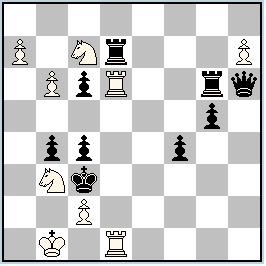
8/1p1k1s2/1p1pqp2/1s1P1r2/1Pb1pRP1/3B4/8/5K2
h#3 twin b) bPd5 C+ 6+11
|
Problem-570
Helpmate in 3
a)
1.Bxd5 Bxe4 2.Kc6 Bf3 3.Qd7 Rc4#
b) wPd5->bPd5
1.Re5 Rxe4 2.Qe7 Re2 3.Ke6 Bf5# |
If we simply say here "white unpins", we lose the actual theme in a higher level. Let us watch closely the dance of the pieces, which the language somehow awkwardly describes : (How the unpinned piece pins its unpinner and then is self-pinned to unpin a pinned friendly piece, which makes a pin-mate! And this is mutually happening!).
First solution (with wPd5): The bBc4 unpins wBd3. The wBd3 captures bPe4 to open the line of the (pinned) wRf4 and to "preventively" pin bBd5. The bK goes to c6 and the bBd5 is now pinned. The wBe4, maintaining the pinning of the bB, goes to f3 to unpin wRf4. The bQe6 blocks its king on d7. The wR mates from c4 (from where started bBc4) and it cannot be captured by the pinned bBd5.
Second solution (with bPd5): The bRf5 unpins wRf4. The wRf4 captures bPe4 to open the line of the (pinned) wBd3 and to "preventively" pin bRe5. The bQe6 "preventively" blocks its king on e7. The wRe5, maintaining the "preventive" pinning of the bR, goes to e2 to unpin wBd3. The bK goes to e6 and the bRe5 is now pinned. The wB mates from f5 (from where started bRf5) and it cannot be captured by the pinned bRe5.
The solutions have pieces which exchange roles and they are named homo-strategical solutions.
Monday, May 07, 2012
Tourney Ikaros, 2012
35th Ikaros International Chess Tournament 2012
Aegean Open Championship 2012
(7-15 July 2012, Agios Kirykos, Ikaria
island, GREECE)
Dates: 7-15 July 2012.
Playing System: Nine (9) Rounds Swiss. FIDE rules apply.
Rate of play: Ninety (90) minutes plus 30 seconds per move (from move 1)
for the completion of the game for each player. Players that do not show up for
their game after one (1) hour from the official start of a round are be forfeited.
Schedule: 1st Round: Saturday 07/7 7.00 p.m.
2nd Round: Sunday 08/7 7.00 p.m.
3rd Round: Monday 09/7 11.00 a.m.
4th Round: Monday 09/7 7.00 p.m.
5th Round: Tuesday 10/7 7.00 p.m.
6th Round: Wednesday 11/7
7.00 p.m.
7th Round: Thursday 12/7 7.00 p.m.
8th Round: Friday 13/7 7.00 p.m.
9th Round: Saturday 14/7 11.00 a.m.
Prize Giving: Sunday 15/7 11.00 a.m.
Tie-breaks: 1. Bucholtz
2.
Median Bucholtz
3.
Number of wins
4.
Sum of progressive scores
Prizes: The prizes will be € 3000 in total and
will be shared as follows:
General Standings: Special Categories:
1st winner € 800 1st Lady €
300
2nd winner €
500 2nd Lady € 160
3rd winner €
200 3rd Lady € 100
4th winner € 160 4th
Lady € 60
5th winner € 130 5th
Lady € 30
6th winner € 100 1st
Veteran € 130
7th winner € 80 2nd
Veteran € 80
8th winner € 60 3rd
Veteran € 40
9th winner € 40
10th winner € 30
Important Note 1: The female and veteran
players, who are eligible for two money-prizes (general standings and special
category), receive both prizes, one from the general standings and one
from the special category. Cup prizes and medals will be awarded to all winners
of the tournament. Medals will also be awarded to the three best juniors and
girls in the categories below 20, 18, 16, 14, 12, 10, 08 years of age.
Important Note 2: The money-prizes
are divided according to the Hort system among the players
with the same final score. (With Hort system every player gets first 50% of the
prizes according to his rank. The other 50% are distributed uniformly within a
scoregroup over the players).
Winners of the Aegean Championship:
The first Greek male and female chess players – members of chess clubs in the Aegean region - will be declared the Man and Woman Aegean Champion 2012 respectively.
Entry
Fee:
The entry fee for the Aegean Open
Championship 2012 is € 50 (for
players below 20 years of age and Members of chess clubs in the Aegean region € 30).
This fee does not apply to
holders of international titles (GM, IM, FM, WGM, WIM, WFM), chess-players that
have already qualified, members of the Ikaria Chess Club and Ikarian
chess-players regardless of the club they belong to.
3nd
Mediterranean Rapid Team Tournament “Ikaros” 2012:
The Mediterranean Rapid Team Tournament
is a rapid Swiss tournament for teams. Participation is open to teams coming
from the chess federations of the countries of the Mediterranean
Sea. Further details will be announced in a complementary announcement.
Participation Fees:
Ikaros
International Chess Tournament celebrates its 35th edition this
year. For this reason the organizers will offer a 20% discount over normal
prices for all participants that will have entered their participation for the
event by the 30th
of June 2012 -the latest- The special discount offer includes:
- Accommodation costs (in double room, the board (food) expenses, meals, breakfast etc are Not included)
- Entry fee.
- Transportation (by bus) from the Therma and Aghios Kirykos (i.e. the places where participants reside during the tournament) to the playing venue 30 minutes prior the beginning of each round.
- Transportation (by bus) from and to the port of Evdilos at the day of the scheduled arrival (7/7) and departure (15/7) of the group of chess players from Ikaria in case this is necessary due to the ferry schedule.
The special price
is set at € 200 per person (instead of € 250 the previous years) for the period
from the 7th until the 15th of July.
Players requesting
for some special room conditions or wish to spend some extra days in Ikaria should notify the organizers in advance.
Additional fees will be charged according to the conditions requested.
For families (at least 3 members),
four-member (at least) club teams, junior players under the age of 20, natives
of the Aegean region and unemployed persons (bearing a valid
unemployment card) the special price is set to € 175 per person for the
period from the 7th until the 15th of July.
Participants who
will pay in advance (until 30th
of June 2012) the special price for the period 7th till 15th
of July becomes € 190 per person,
while for those who are eligible for the family discount (i.e., families, juniors, club teams,
natives, etc.) the respective special price for the period 7th till
15th of July becomes € 165
per person. The amount due should be deposited until the 30th of June 2012 through bank transfer to the
account 077/947995-31 of National Bank of Greece (the account is in the name of Mr. Kosmas Kefalos, ΙΒΑΝ: GR91 0110
0770 0000 0779 4799 531, SWIFT CODE (BIC) ETHNGRAA,). Participants should hold a copy of their deposit
receipt (including the name of the participant) and present it to the
organization committee upon arrival at Ikaria.
Note 1: The above prices
apply also for the accompanying persons, regardless whether they participate or
not in the tournament.
Note 2: Participants wishing to pay
on-site at Ikaria should pay in cash (no
credit cards are accepted)
Conditions to GMs/WGMs, and IMs/WIMs:
For a limited number of titled
players (GMs/WGMs, the IMs/WIMs), and the players that have
qualified from preliminary events, the organization committee covers for:
- Accommodation costs (in double room, the board (food) expenses, meals, breakfast etc are Not included) for the period 7th till 15th of July
- Entry fee.
- Transportation (by bus) from Therma and Aghios Kirykos (i.e. the places where participants reside during the tournament) to the playing venue 30 minutes prior the beginning of each round.
- Transportation (by bus) from and to the port of Evdilos at the day of the scheduled arrival (7/7) and departure (15/7) of the group of chess players from Ikaria in case this is necessary due to the ferry schedule.
Additionally GMs and WGMs will receive € 1 (one
euro) for every rating point above 2300 (based on FIDE rating list of July 2012).
Transportation
to Ikaria:
Ikaria can be reached
either by ferry (from Piraeus,
Mykonos or Samos)
or by plane (from Athens,
Thessaloniki
and Heraklion). For details check with your travel agent or contact the
organization committee for additional info.
Contact Information:
For more
information please contact:
Mr. Dimitris Kapagiannidis at: (++30)
6947-829772 or
Mrs. Antzela Shaka at: (++30)
6977-730286
For possible updates and
additional information concerning the Ikaros International Chess Tournament 2012,
and the island of Ikaria, you can visit: http://ikariachess.blogspot.com, http://www.ikaroschess.gr, http://www-island-ikaria.com, http://www.nikaria.gr and http://www.ikariamag.gr
[1] Ikaria is an island situated in the eastern Aegean Sea
the name of which was inspired by the myth of Ikaros, a young Greek that died
in the region in an attempt to fly on wings made from wax fleeing from the
Cretan King Minos. For information about Ikaria
island see: http://www.island-ikaria.com/,
http://www.nikaria.gr, http://www.ikariamag.gr
Subscribe to:
Posts (Atom)